
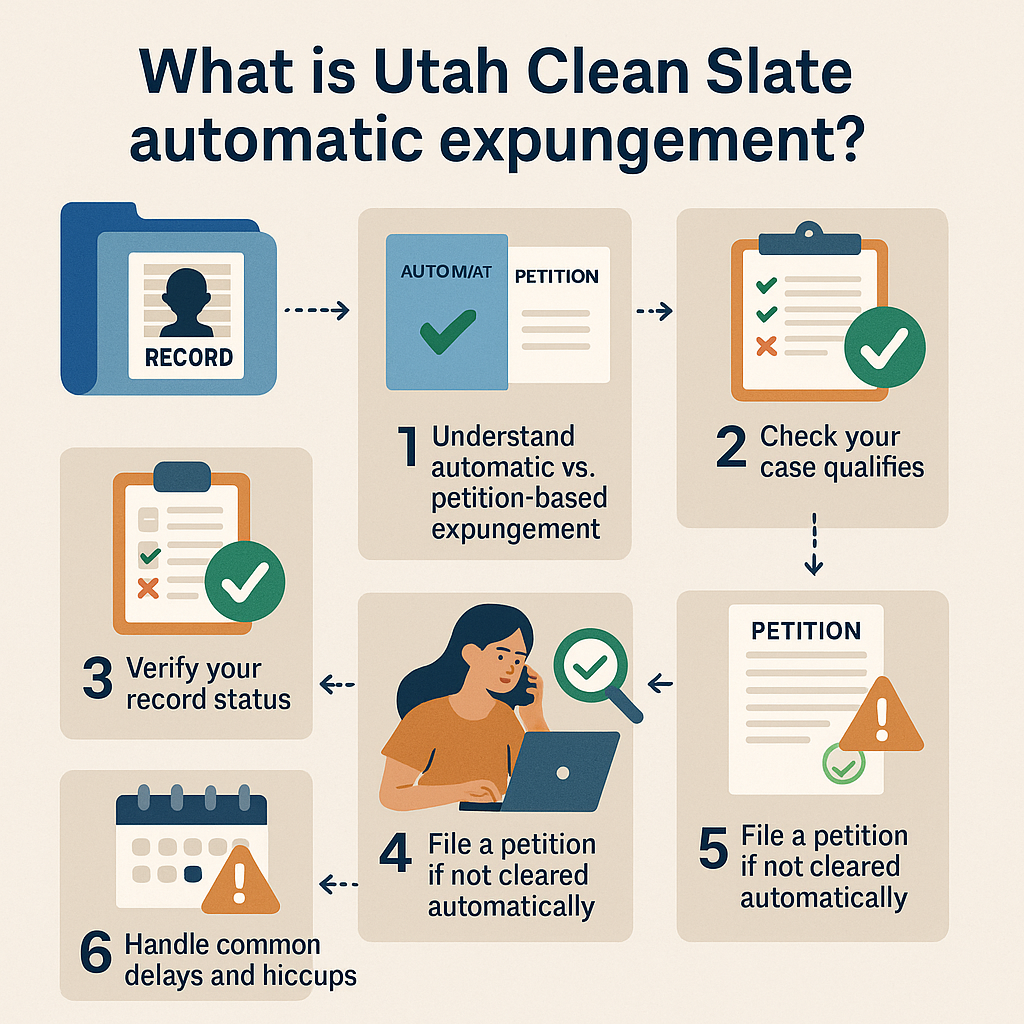
What is Utah Clean Slate automatic expungement
Who qualifies, how the automatic process works, and what to do if your record is not cleared yet
Utah’s Clean Slate law gives thousands of people a second chance by automatically clearing certain old criminal records with no lawyer and no court filing needed. Not every record qualifies, and even eligible cases can be delayed. This guide explains how automatic expungement works, who qualifies, and how to follow up if your record has not cleared.
Automatic vs petition based expungement
Utah recognizes two paths to clearing a record: automatic expungement and petition based expungement.
Automatic expungement. Utah’s Clean Slate system identifies qualifying cases and clears them after set waiting periods, without you filing paperwork.
Petition based expungement. You apply through the Bureau of Criminal Identification (BCI) for a Certificate of Eligibility, file a court petition, and may attend a hearing.
Automatic expungement simplifies the process, but it does not cover every record, so knowing which path applies is critical.
Who qualifies under Clean Slate
- Eligible categories. Certain class C and class B misdemeanors, infractions, and non convictions such as dismissals or acquittals.
- Waiting periods. A crime free period is required for clearance, commonly about 5 to 7 years without new convictions.
- Excluded offenses. Violent crimes, DUI, sex offenses, and felonies are not eligible for automatic clearance. These may still be addressed through petition based expungement if you meet the requirements.
How to verify your status
Check your record through the Utah BCI:
- Visit the Utah BCI site to request your criminal history report.
- Review which cases show as “eligible for automatic expungement.”
- If something looks off, contact BCI or the Utah Clean Slate Project for confirmation.
Delays are common when court, prosecutor, or warrant system data is not fully synced.
Certificates and record updates
If your case qualifies but has not cleared yet, you can take steps to move it along:
If your record was not cleared automatically
You can still pursue a manual expungement:
- Obtain a Certificate of Eligibility from BCI.
- File an expungement petition in the appropriate court.
- Notify the prosecutor and attend a hearing if required.
Petition based expungement is the fallback when automation misses a qualifying case.
Common delays and how to handle them
- Court data not syncing correctly with BCI.
- Unpaid fines or restitution.
- Recent convictions that reset waiting periods.
Video and social learning hub
YouTube: Utah Clean Slate
Instagram: Clean Slate stories and explainers
Need help applying this to your situation
If you believe you qualify but have not seen clearance yet, verify status with BCI and consider petition based expungement for missed cases. For complex facts, a Utah expungement attorney can help.
Talk to a Utah AttorneyFor more plain English legal guidance, stay updated with Utah Law Explained, explore our mission on the About Us page, or connect with trusted counsel like Gibb Law Firm.