
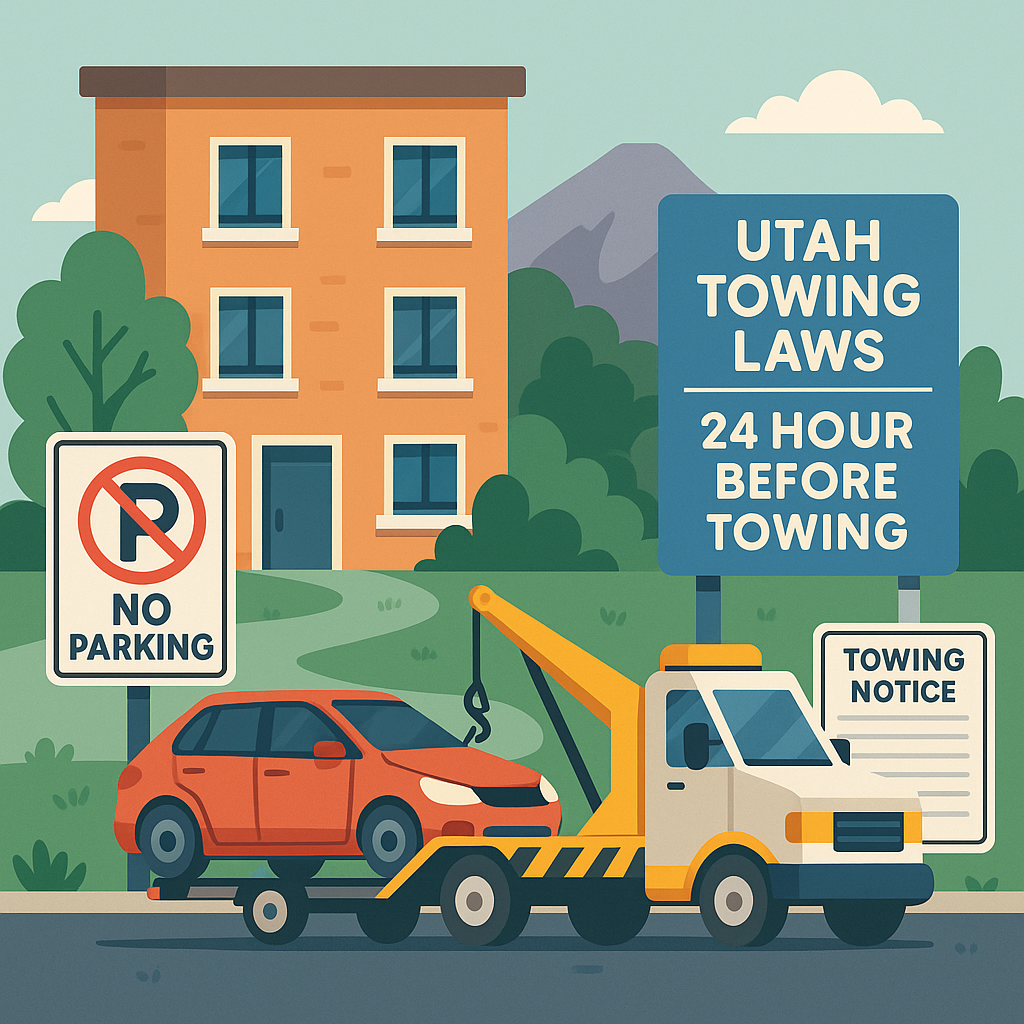
Utah Towing Laws for Apartment Parking Lots
Plain-English guide to tow-warning signs, tenant rights, legal fees, and disputing wrongful towing in Utah apartment communities.
Getting your car towed from your apartment parking lot is stressful, expensive, and, in some cases, may be unlawful. Utah law sets clear rules on when an apartment complex can tow a vehicle, what warning signs must look like, how much towing and storage can cost, and how tenants can challenge wrongful or predatory towing. This guide breaks those rules down in plain English so you can recognize legal towing, push back on illegal towing, and take practical next steps if your car is already gone.
Overview: Utah Rules for Apartment-Lot Towing
In Utah, towing from private property including apartment complexes is regulated. A landlord, property manager, or HOA usually cannot tow at will. Instead, they must follow state requirements around tow-warning signs, authorization, fees, paperwork, and how vehicles are released.
At a high level, legal towing from an apartment complex in Utah depends on three big questions:
- Was there proper signage? Clear tow-warning signs must be posted at entrances and in restricted areas.
- Was the tow properly authorized? Someone with legal authority (not just a random resident) must approve most non-emergency tows.
- Were fees and paperwork handled correctly? Utah caps many charges and requires documentation so owners can find and recover their vehicles.
If the answer to any of these questions is “no,” the tow may be improper under Utah law.
Required Tow-Warning Signs in Utah Apartment Lots
Utah law focuses heavily on signage. If you were towed from an apartment lot, the first thing to look at is whether the tow-warning signs meet state requirements.
Key basics typically include:
- Entrance signs. Tow-warning signs should be placed at vehicle entrances so drivers know they are entering a private lot where towing can occur.
- Size and visibility. Signs must be reasonably large, readable, and visible both in daylight and at night.
- Mandatory information. Signs should state that unauthorized vehicles may be towed, list the towing company’s name and phone number, and reference applicable towing fees.
- Reserved-space notices. If certain stalls are reserved or assigned, that restriction should appear either on signs or in clear written rules given to tenants.
When tow-warning signs are missing, hidden, or confusing, that can strongly support a claim that the tow was improper or predatory.
When Can an Apartment Complex Tow Your Car?
Even with proper signage, a Utah apartment complex still needs a valid reason to tow. Common grounds for towing include:
- No-parking or red-curb zones. Parking in clearly marked fire lanes, loading zones, or “No Parking” areas.
- Blocking others. Blocking another resident’s car, a dumpster, a driveway, or a building entrance.
- Reserved or assigned spaces. Using a numbered or assigned stall without authorization from the resident or management.
- Violating written parking rules. Breaking clearly stated rules in your lease or community handbook (for example, parking unregistered or inoperable cars in resident stalls).
- Abandoned vehicles. Leaving a vehicle unmoved or obviously inoperable for long periods, especially when the lease treats that as a violation.
Some situations allow immediate towing, especially where safety is involved. Examples include blocking emergency access, fire lanes, or entrances that emergency vehicles need to use.
In less urgent situations, Utah law often expects the property to follow reasonable notice and authorization practices. If your vehicle was towed without any obvious violation, that is a red flag.
Your Rights After Your Car Is Towed
Once your car has been towed, it is easy to feel powerless. Utah law still gives you important rights as a vehicle owner or tenant.
In many cases, you are entitled to:
- Information about the tow. Using the phone number on the sign or notice, you should be able to learn where your vehicle is, what time it was towed, and why.
- Basic documentation. You can request tow-authorization forms, photos of the alleged violation, and paperwork showing who authorized the tow.
- Reasonable payment options. Tow yards should accept common forms of payment and cannot tack on hidden or arbitrary “gate fees” not allowed by Utah rules.
- Prompt release once you pay lawful fees. Once you pay the legitimate towing and storage charges, the operator should release your car within normal business hours without unnecessary delay.
If the towing company refuses to provide documentation, makes it nearly impossible to retrieve your car, or inflates the bill beyond Utah limits, those may be signs of predatory or unlawful practices.
Tow, Storage, and Release Fees in Utah
Utah places guardrails on what towing companies can charge for private-property tows. While exact fee caps can change over time, the big ideas stay consistent:
- Maximum tow fees. Utah sets ceilings on what companies can charge based on vehicle type and towing distance.
- Daily storage limits. Storage fees are usually charged per day and must stay within Utah-approved limits.
- Reasonable business hours. Tow yards must keep posted hours that allow owners a fair opportunity to recover their vehicles.
- Itemized receipts. You are entitled to a receipt that breaks down towing, storage, and any other lawful charges.
If your bill seems unusually high, ask for an itemized breakdown and compare it to Utah’s current private-property towing limits. Significant overcharges can help support a refund request or legal complaint.
How to Dispute Illegal or Predatory Towing
If you believe your car was wrongfully towed from your apartment parking lot, a structured approach can improve your chances of getting relief. Here is a step-by-step framework many Utah tenants follow:
- Document the scene. Take photos of parking-lot entrances, the stall where you parked, nearby signs (or lack of signs), and any paint markings or curb labels.
- Collect your paperwork. Save the tow receipt, payment records, and any written communication from the property manager or towing company.
- Request tow documentation. Ask the towing company and property manager for copies of tow-authorization forms, photos they relied on, and records showing compliance with Utah law.
- Compare against Utah rules. Check whether the signage, reasons for towing, and fees line up with Utah requirements for private-property towing.
- Raise the issue with management. Calmly present your evidence to the apartment manager or landlord. Some are willing to reimburse fees when they realize the tow was not properly justified.
- File a complaint if needed. If the tow appears unlawful or predatory, you may file a complaint with local law enforcement, Utah’s consumer protection authorities, or the city or county that regulates towing practices.
- Consider legal guidance. For larger financial losses or repeated abuses, talking with a Utah attorney can help you evaluate next steps, including potential claims for damages.
Careful documentation especially photos and timestamps, often makes the difference between a rejected complaint and a successful challenge.
Videos & Social Posts on Utah Towing and Parking Disputes
YouTube: Utah Towing Stories & Enforcement
Instagram: Real-Life Parking & Towing Experiences
Need Help Applying This to Your Situation?
Every towing situation has its own facts where you parked, what the signs said, who authorized the tow, and how the fees were calculated. If you are unsure whether your apartment-lot tow followed Utah law, speaking with a Utah attorney can help you understand your options and next steps.
Talk to a Utah AttorneyFor more plain-English legal guidance, stay updated with Utah Law Explained, explore our mission on the About Us page, or connect with trusted counsel like Gibb Law Firm.