
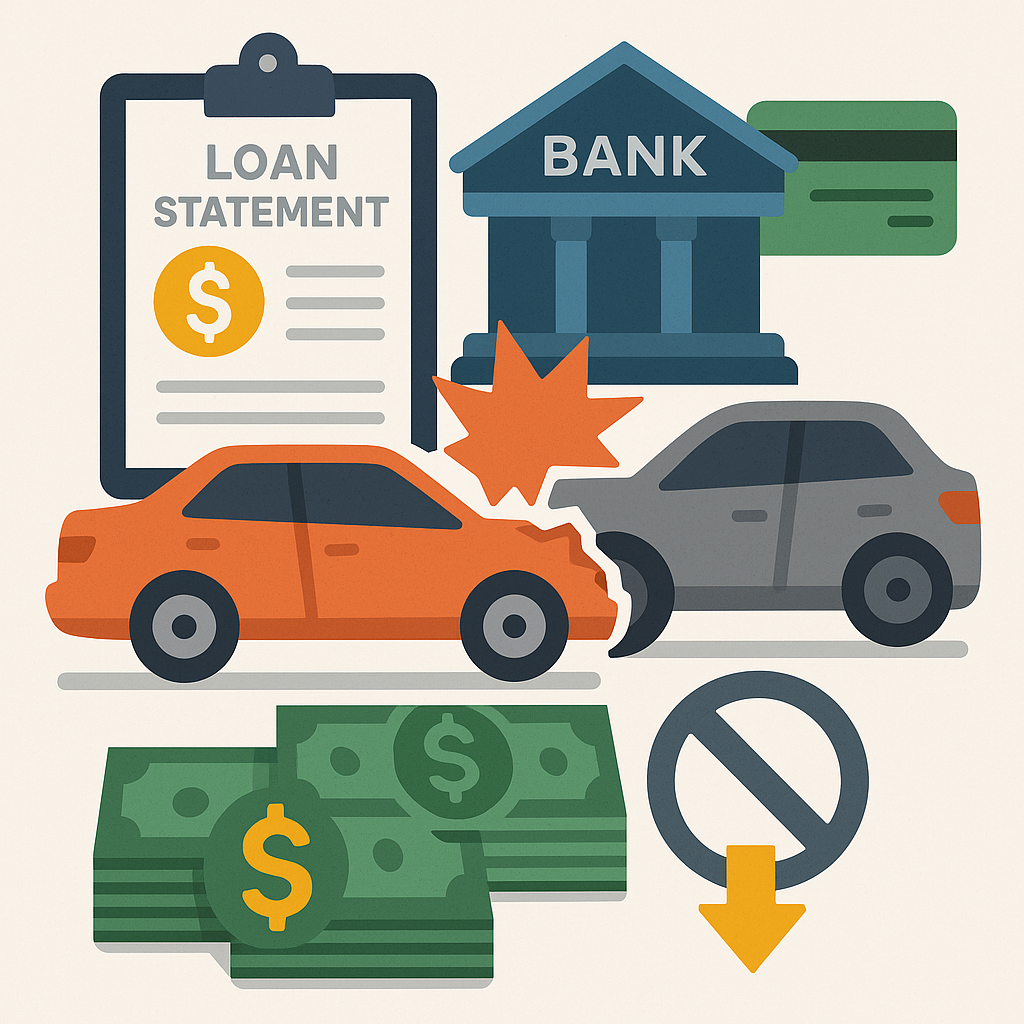
Utah Rights When Your Car Is Totaled but Still Financed
Plain-English guide to insurance payouts, loan balances, deficiency amounts, gap coverage, and lender rights in Utah.
When a crash in Utah totals your vehicle, the insurance company looks at the car’s value not the size of your auto loan. That means a totaled car does not automatically wipe out what you owe, and you can be left with a painful “gap” between the payout and your remaining balance.
This guide explains how total loss works when your car is financed, how insurance companies calculate actual cash value (ACV), when gap insurance can save you from a deficiency balance, and what rights you have to dispute a low offer or push back if your lender overreaches.
When a Financed Car Is Declared a Total Loss in Utah
In Utah, a vehicle is treated as a “total loss” when the cost to repair it approaches or exceeds most of its market value. Once the insurer declares your car totaled, the company stops paying for repairs and instead offers a lump-sum based on the car’s actual cash value (ACV) right before the crash.
For a financed car, three things happen quickly:
- The insurer calculates ACV using age, mileage, condition, and comparable sales.
- Because your lender is a lienholder, the insurance company pays the lender first.
- If ACV is less than your loan payoff, you may still owe money even though the car is gone.
Understanding that ACV, not your payoff, drives the payout is the first step in protecting your rights after a total loss in Utah.
Insurance Check vs. Loan Balance: Who Gets Paid First?
When a financed vehicle is totaled, the insurance company cuts the check with your lender in mind. Your lender is listed as a loss payee on the policy, so the insurer usually issues the payout directly to the lender, or to you and the lender together.
At a high level, the flow looks like this:
Comparison Guide: ACV Payout vs. Remaining Loan
The table below compares the most common totaled-car scenarios for Utah drivers with financed vehicles, and what each outcome usually means for your wallet.
| Scenario | What Insurance Pays | Effect on Your Loan | Typical Result for You |
|---|---|---|---|
| ACV > Loan Payoff | Insurer pays ACV, lender is paid in full. | Loan is closed; any leftover funds go to you. | Positive equity — you may receive a check. |
| ACV ≈ Loan Payoff | Insurer pays roughly what you owe. | Loan is paid off but no extra remains. | Break-even — you walk away without owing, but no surplus. |
| ACV < Loan Payoff (No Gap Coverage) | Insurer pays ACV only. | Lender applies payout, leaving a deficiency balance. | You still owe the remaining balance to the lender. |
| ACV < Loan Payoff (With Gap Insurance) | Primary insurer pays ACV; gap policy covers part or all of the shortfall. | Loan is usually paid down to $0 after both payments. | Little or no deficiency you may still be out a deductible. |
If you are in the third scenario, ACV is lower than your payoff and there is no gap coverage, it becomes especially important to look hard at the valuation and make sure your car was not underpriced.
Gap Insurance: When It Covers the Difference
Gap insurance is designed for the exact situation many Utah drivers fear: you owe more on your auto loan than your car is worth when it is totaled. The coverage is meant to “bridge the gap” between the ACV payout and your remaining payoff.
In practice, gap coverage often:
- Pays the lender part or all of the deficiency balance after the main insurer’s ACV payment.
- Prevents a large surprise bill when your loan balance is higher than expected.
- Still leaves you responsible for your deductible, late fees, or non-covered add-ons.
Sometimes gap insurance is sold at the dealership and rolled into the loan. Other times it is purchased separately from an insurance company. Either way, if your financed car is totaled in Utah, it is worth carefully reviewing your contract and policy documents to see if you already have gap coverage before assuming you are stuck with the full deficiency.
How to Respond to a Low Total Loss Offer in Utah
Many Utah drivers feel the first total loss offer is too low. You are generally allowed to ask the insurer for details and push back if the valuation does not reflect your actual vehicle.
Key rights commonly include the ability to:
- Request the valuation report and comparable vehicles the insurer used.
- Point out incorrect information about mileage, trim level, or options.
- Provide your own Utah-based comparable listings showing higher prices.
- Question deductions for condition if they do not match your records or photos.
From a strategy standpoint, Utah drivers usually have three main paths when they disagree with an offer or face a large deficiency balance:
| Option | Best When | Pros | Tradeoffs |
|---|---|---|---|
| Negotiate ACV | You have strong evidence your car is worth more. | Can increase payout and reduce or remove a deficiency. | Takes time, requires research and persistence. |
| Use Gap Insurance | You carried gap coverage when the crash happened. | Can wipe out most of the remaining loan. | Does not usually refund your deductible or fees. |
| Settle Remaining Balance | Offer seems fair and no coverage is available. | Resolves the debt and lets you move on. | May require a lump sum or payment plan with the lender. |
If the numbers are large, getting individualized legal or financial advice can help you decide which option fits your situation and bargaining power.
Your Lender’s Rights After a Total Loss and Common Pitfalls
When your financed car is totaled, your lender still holds a lien until the loan is fully paid. That gives the lender a strong say in how the insurance check is applied, but it does not give them unlimited power.
Common lender rights generally include:
- Receiving the insurance payout directly as a loss payee.
- Applying the funds to your payoff according to the loan terms.
- Seeking payment for any verified deficiency balance that remains.
Common pitfalls Utah drivers run into include:
- Assuming the loan is gone just because the car is gone, only to be surprised by a collection notice later.
- Not requesting a written payoff calculation to see exactly how the insurer’s payment was applied.
- Ignoring a small deficiency balance until late fees or collection activity makes it more expensive.
If something does not add up in the payoff math, it is usually better to ask questions early, in writing, rather than waiting until the account is referred to collections.
Video & Social Learning Hub: Totaled Cars & Auto Loans
YouTube: When Your Financed Car Is Totaled
Need Help Applying This to Your Situation?
A totaled financed car can leave Utah drivers juggling insurance valuations, loan payoff numbers, and surprise deficiency balances all while trying to find a replacement vehicle. Acting quickly when you receive the total loss letter, reviewing the valuation, and checking for any gap coverage can sharply reduce your out-of-pocket costs and confusion.
Talk to a Utah AttorneyFor more plain-English legal guidance, stay updated with Utah Law Explained, explore our mission on the About Us page, or connect with trusted counsel like Gibb Law Firm for case-specific advice.