
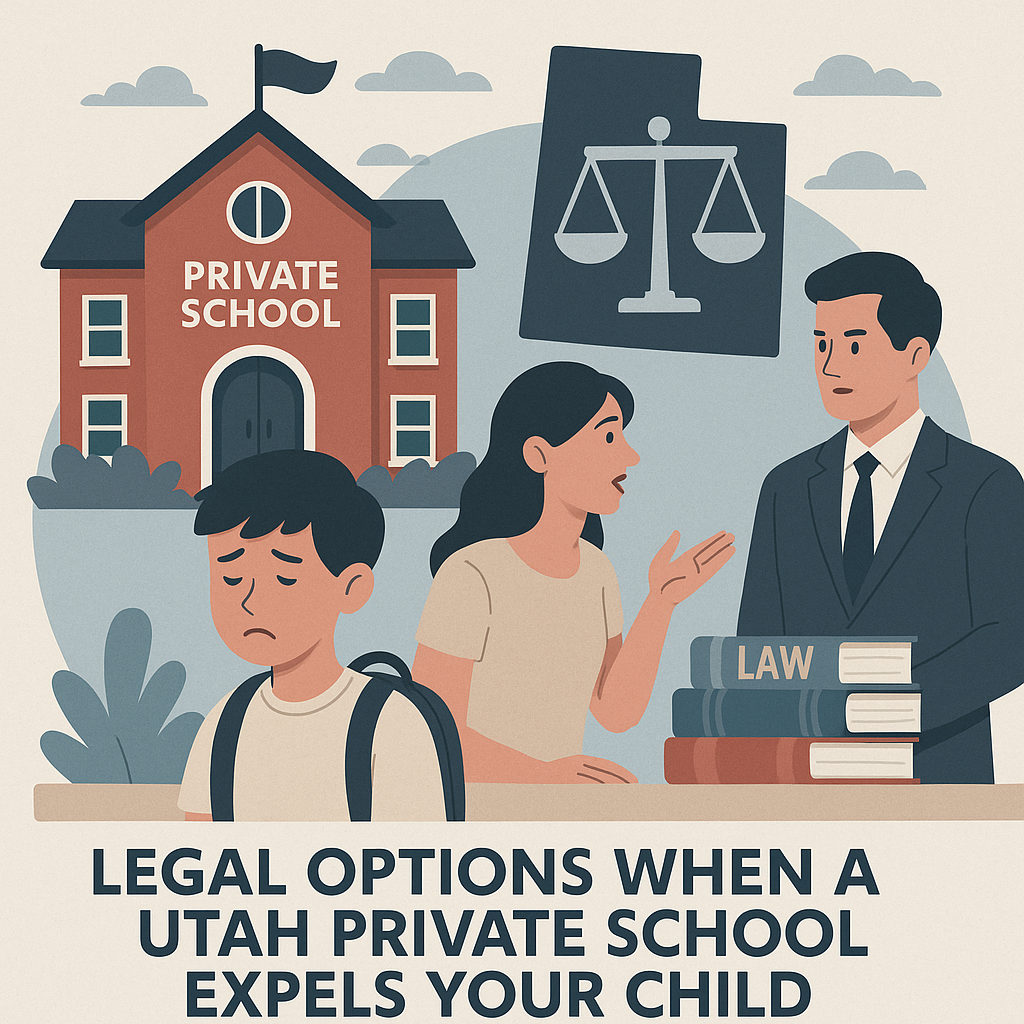
Legal Options When a Utah Private School Expels Your Child
How contracts, handbooks, discrimination rules, and negotiation shape your options after a private school expulsion.
Private schools in Utah have more flexibility than public schools, but they are not allowed to act arbitrarily. When a child is expelled, parents often feel blindsided and powerless, unsure what rules even apply.
In reality, private schools must follow their own enrollment contracts, handbooks, and discipline procedures. This guide explains how those documents create leverage for families, when expulsion may be discriminatory or unfair, and what practical steps you can take to protect your child’s record and future options.
Start With the Enrollment Contract
Unlike public schools, which are ruled by constitutional and statutory frameworks, most disputes with Utah private schools are governed by contract law. The enrollment contract you signed at the start of the year is usually the foundation for everything that comes next.
When your child is expelled, pull out the contract and look for clauses about:
- Discipline and expulsion standards – what conduct can lead to suspension or expulsion.
- Procedures the school promises – written notice, meetings, or opportunities for the student to respond.
- Appeal or review rights – any internal committee or process for challenging decisions.
- Refund or tuition obligations – whether the school can keep paid tuition after expulsion.
- Reservation-of-rights language – clauses that say the school can change rules mid-year.
If the school did not follow its own contract for example, by skipping steps or ignoring promised notice that inconsistency can give parents strong leverage to challenge the decision or negotiate a better outcome.
Review the Parent & Student Handbook
Many Utah private schools treat the parent and student handbook as an extension of the contract. Courts often pay attention to handbooks when schools distribute them, require signatures, and clearly expect families to follow them.
As you read the handbook, ask:
- Does it list specific behaviors that qualify for suspension or expulsion?
- Does it promise progressive discipline (warnings, detentions, suspensions) before expulsion?
- Did the school provide the required written notice before expelling your child?
- Was your child offered a chance to tell their side of the story or meet with decision-makers?
- Has the school applied the same rules to similarly situated students, or is your child being treated differently?
Expulsions often become legally vulnerable when schools ignore or selectively enforce their own handbook rules. Inconsistency between what the handbook promises and what actually happened is a red flag worth documenting.
When Expulsion May Be Discriminatory or Unfair
Private schools do not have to follow every rule that binds public districts, but they still face limits especially when it comes to discrimination and honesty in how they present their programs and policies.
Legal concerns may arise if a Utah private school:
- Disciplines or expels a student based on race, religion, national origin, disability, or other protected characteristics.
- Applies rules much more harshly to your child than to others for the same conduct.
- Advertises a particular discipline process but does something entirely different in practice.
- Retaliates against your child or family after you raise concerns or complaints.
In some circumstances, Utah’s consumer protection and unfair/deceptive practices laws may apply if the school’s marketing and policies do not match reality. If you suspect discrimination or misrepresentation, it is wise to speak with an attorney familiar with education or civil rights law before signing anything or making final decisions.
Appeal & Negotiation Options for Families
Even when a private school technically has the power to expel a student, parents still have practical options. Some are spelled out in school documents; others arise from negotiation and the school’s own reputational interests.
- Internal appeal. Many handbooks allow appeals to a discipline committee, head of school, or board. Appeals are strongest when you can point to specific contract or handbook violations.
- Convert expulsion to withdrawal. Schools will sometimes agree to record a “voluntary withdrawal” instead of an expulsion, which can greatly reduce long-term impact on transcripts and future applications.
- Negotiate tuition and financial issues. Depending on timing and circumstances, families may negotiate partial tuition refunds, release from future payments, or adjustments to payment plans.
- Clarify the student’s record. You can ask the school to remove or narrow negative notations, provide a neutral reference letter, or agree to specific language if future schools call.
- Consider legal action or complaints. In more serious cases such as suspected discrimination, broken promises, or misrepresentation parents may consider contract claims, civil rights complaints, or consumer complaints after speaking with counsel.
Document every communication with the school and keep copies of emails, letters, and policy documents. A clear paper trail can be invaluable if you escalate the dispute.
Case Study: When Paperwork Changed Everything
A Utah family enrolled their 9th-grade child in a private school known for strict discipline. After a heated argument between students, the school immediately expelled the child with a brief phone call and no written explanation.
Feeling stunned, the parents reviewed the enrollment contract and handbook. They discovered:
- The contract required two documented incidents of serious misconduct before expulsion.
- The handbook promised a parent conference and written notice before any expulsion would be final.
- The child’s file contained no prior disciplinary notes for the school year.
Armed with this documentation, the parents requested an internal review. During the meeting, administrators acknowledged that the process had been rushed and did not match the written policies. After negotiation, the school agreed to:
- Reverse the expulsion decision.
- Allow a voluntary withdrawal instead.
- Provide a partial tuition refund for the remaining semester.
- Remove negative remarks from the student’s internal record.
The family still chose a different school, but the outcome was far better than a permanent expulsion on the child’s record. The case illustrates a broader pattern: once parents carefully review contracts and handbooks, they often uncover leverage they did not know they had.
YouTube & Instagram: School Discipline & Expulsion
YouTube: Understanding Expulsions & Student Rights
Instagram Reels: Real Stories & Legal Context
Expulsion Isn’t the End of the Story
Expulsion from a private school feels overwhelming, but a careful review of contracts, handbooks, and discipline procedures often reveals options families didn’t realize they had. If you are unsure how to challenge the decision, protect your child’s record, or negotiate a better outcome, a Utah education or family law attorney can help.
Talk to a Utah AttorneyFor more plain-English legal guidance, stay updated with Utah Law Explained, explore our mission on the About Us page, or connect with trusted counsel like Gibb Law Firm.