
Pedestrian Accidents in Utah: Crosswalk Laws and Shared Fault Rules
Plain-English guide to Utah crosswalk rules, jaywalking, shared fault, and what happens after a pedestrian crash.
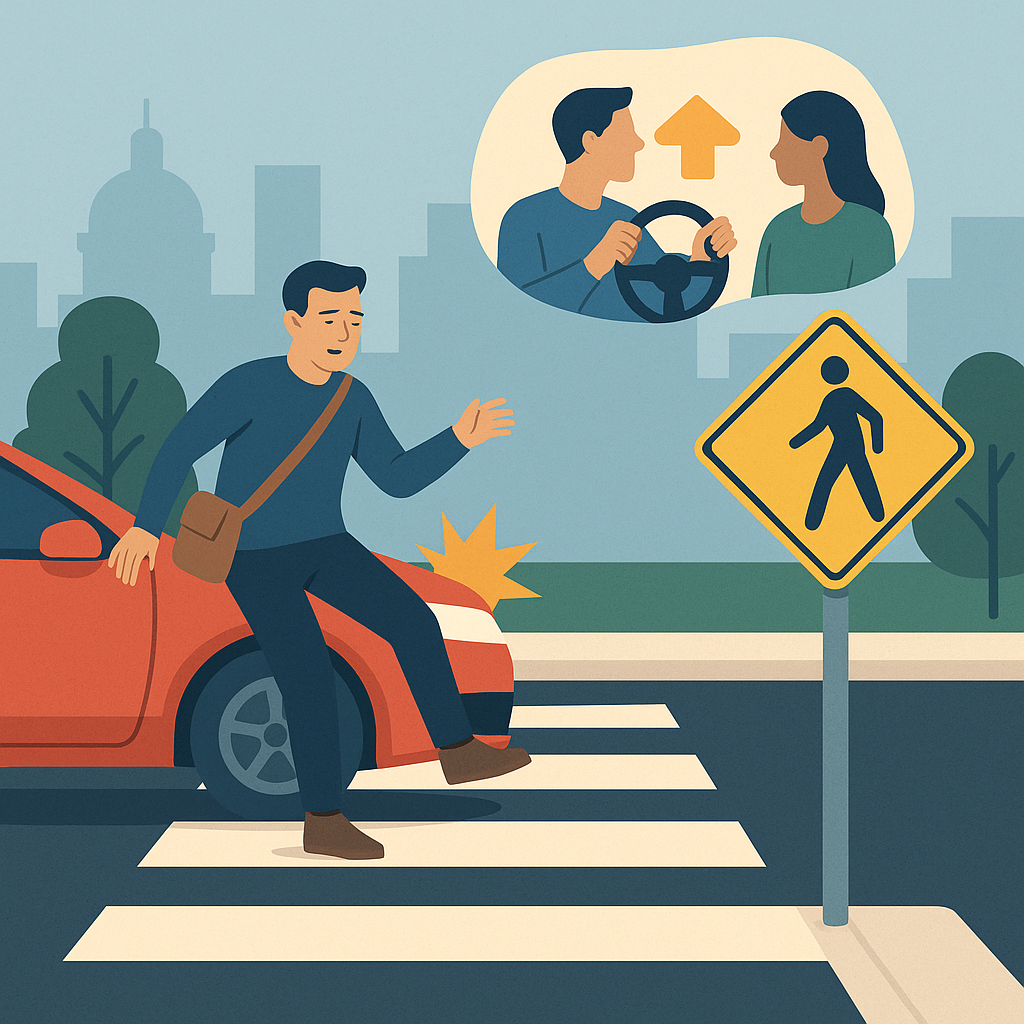
Pedestrians in Utah have important rights but also real responsibilities under state traffic law. When a collision happens, the outcome rarely turns on a single detail like “the pedestrian had the right of way.” Instead, Utah courts look at whether both the driver and the pedestrian followed crosswalk rules, traffic signals, and basic safety standards under Utah’s comparative negligence system.
This guide breaks down how crosswalks work, where jaywalking becomes risky, how fault is divided after a crash, and what to expect from insurance claims if you are hit while walking in Utah.
Utah Crosswalk Laws: Where Pedestrians Have the Right of Way
Utah law protects pedestrians in both marked and certain unmarked crosswalks. A crosswalk is not just lines of paint on the road. Any intersection where sidewalks on opposite sides would connect across the street can be treated as an unmarked crosswalk, unless signs say otherwise.
Drivers must yield and, if necessary, stop when:
- A pedestrian is in a marked crosswalk on the driver’s half of the road or approaching it closely.
- A pedestrian is in an unmarked crosswalk at an intersection and crossing reasonably.
- A school crossing guard or signal gives pedestrians the right to cross.
Even when a driver has a green light, the law still requires them to watch for pedestrians in the crosswalk before turning right or left. Failing to yield can support traffic citations, civil fault, or both.
When Pedestrians Do Not Have the Right of Way
Utah traffic rules also place limits on pedestrians. Having the word “pedestrian” in an accident story does not automatically mean drivers are to blame. Pedestrians can lose the right of way or share fault when they ignore signals or create sudden hazards.
Under Utah law, pedestrians may not:
- Step suddenly into the path of a vehicle that is so close it cannot reasonably stop.
- Enter the roadway while facing a solid “Don’t Walk” or red hand signal.
- Walk along the roadway where sidewalks are provided and usable, except where unavoidable.
- Cross in areas with posted “No Pedestrian Crossing” signs.
Courts look closely at what each person actually did driver speed, braking, distraction, and lighting, along with where and how the pedestrian crossed.
Jaywalking in Utah: Is It Illegal and How Does It Affect Fault?
“Jaywalking” is often used casually, but Utah law does not make every mid-block crossing illegal. The key questions are: where the person crossed, what the traffic signals and signs said, and whether the pedestrian created an unreasonable hazard.
In general:
- Crossing mid-block may be allowed where there are no nearby signals and no signs prohibiting crossing.
- Crossing between two signalized intersections on a busy corridor is often prohibited; pedestrians are expected to use the signals.
- Ignoring a clearly posted “No Pedestrian Crossing” sign can lead to citations and significant fault in a later injury case.
Because Utah uses comparative negligence, a jaywalking pedestrian might still recover some compensation if the driver was speeding, distracted, or failed to keep a proper lookout, but the pedestrian’s share of fault will reduce the final award.
Comparison Guide: Pedestrian vs. Driver Duties at Crosswalks
This comparison guide summarizes how Utah law generally treats typical pedestrian-driver encounters. The percentages are only illustrative; in real cases, judges, juries, and insurers look at detailed facts, witness statements, and sometimes video footage.
| Situation | Driver duty | Pedestrian duty | Illustrative fault split |
|---|---|---|---|
| Pedestrian in marked crosswalk with “Walk” signal | Slow, yield, and stop if necessary | Stay within crosswalk, don’t suddenly run | Driver 80% / Pedestrian 20% |
| Pedestrian starts crossing late on flashing “Don’t Walk” | Proceed with extra caution | Avoid entering if not enough time to finish | Driver 40% / Pedestrian 60% |
| Legal mid-block crossing in a residential area | Maintain safe speed and lookout | Cross only with a safe gap in traffic | Driver 70% / Pedestrian 30% |
| Crossing where signs prohibit pedestrians | Try to avoid a collision if possible | Obey posted “No Pedestrian Crossing” signs | Driver 30% / Pedestrian 70% |
| Driver turning right on green at busy downtown corner | Yield to crossing pedestrians and check blind spots | Cross when the signal allows, be visible | Driver 90% / Pedestrian 10% |
| Pedestrian steps out from between parked cars at night | Drive at a speed appropriate for visibility | Avoid sudden, hidden entries into traffic | Driver 20% / Pedestrian 80% |
Insurance & Compensation After a Utah Pedestrian Accident
Utah is a no-fault state for auto insurance, which affects pedestrian claims as well. When a person on foot is hit by a car, the driver’s no-fault coverage, called Personal Injury Protection (PIP), usually comes first.
Typical steps include:
- PIP coverage: Pays initial medical bills up to the policy limit (often around $3,000) and may cover some lost wages and household services.
- Liability claim: If injuries are serious or expensive enough, the pedestrian may pursue a liability claim against the driver for pain and suffering, long-term treatment, and other losses.
- Shared fault reduction: Any award is reduced by the pedestrian’s percentage of fault. A pedestrian who is 30% at fault would see compensation reduced by 30%.
Because of these moving parts PIP rules, liability standards, and shared fault, Utah pedestrians often benefit from legal advice, especially when injuries are significant or fault is disputed.
Local Ordinances: How Utah Cities Treat Pedestrian Safety
State law provides the foundation, but Utah cities add their own rules and enforcement priorities. While the details vary, several themes appear again and again:
- Salt Lake City: Extra enforcement in downtown crosswalk corridors and near TRAX lines, with campaigns focused on driver yielding and pedestrian visibility.
- Provo and Orem: Heavy attention to campus areas around BYU and UVU, where large student populations walk and bike; marked crosswalks are closely monitored.
- Ogden: School-zone enforcement and crossing-guard protections are a frequent focus, especially during pick-up and drop-off times.
- St. George and southern Utah cities: Greater emphasis on multi-use paths, trail crossings, and high-speed arterial roads where tourists and locals mix.
Practically, this means a pedestrian accident in downtown Salt Lake City may be evaluated slightly differently than one on a rural highway, even though both rely on the same underlying Utah law.
Video & Social Learning Hub: Utah Pedestrian Safety
YouTube: Crosswalks & Auto–Pedestrian Crashes
Instagram: Real Utah Incidents & Awareness
Understanding Your Rights After a Pedestrian Crash
Pedestrian accidents in Utah are rarely simple. Crosswalk rules, jaywalking claims, driver behavior, and comparative fault all interact to determine who pays what after a crash. Knowing the basics of Utah pedestrian law can help you make better choices on the street and ask better questions if you are ever injured.
Talk to a Utah Injury AttorneyFor more plain-English legal guidance, stay updated with Utah Law Explained, explore our mission on the About Us page, or connect with trusted counsel like Gibb Law Firm.