
Utah Backyard Pool Safety and Liability Rules
Plain-English guide to fencing rules, safety duties, and liability risks for Utah homeowners with backyard pools.
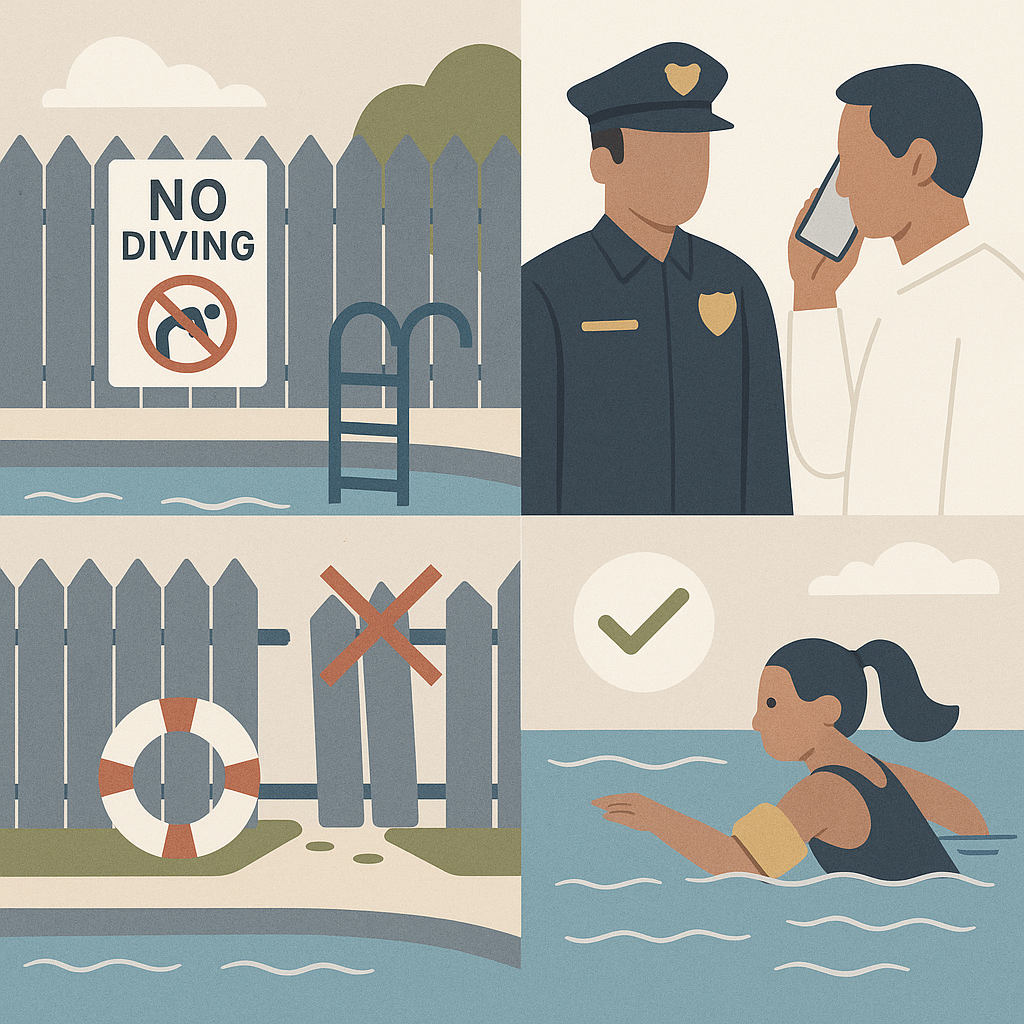
Backyard pools are fun but bring major legal responsibilities for Utah homeowners. Under Utah law, pool owners must take reasonable steps to keep people safe, prevent children from accessing the water unsupervised, and maintain the pool in a hazard-free condition. When an accident happens, liability usually turns on whether the homeowner provided proper barriers, supervision, safety features, and warnings.
This guide breaks down Utah’s backyard pool safety and liability rules in plain English so you know what is expected and how to reduce your risk.
Fencing & Pool Barrier Requirements in Utah
Utah does not have one single statewide residential pool code, but most cities and counties follow similar standards, often based on the International Swimming Pool and Spa Code (ISPSC). That means your exact responsibilities depend on your local city or county ordinance, even though the core ideas are similar across Utah.
Typical local rules for backyard pools include:
- A secure fence around the pool, usually at least 4 feet high.
- Self-closing, self-latching gates that swing outward and latch automatically.
- No large gaps or openings where a child could crawl under, through, or climb over.
- Barriers for hot tubs and spas unless they have a locking safety cover.
Even if your neighbor’s city has looser or stricter rules, you are judged by the rules in your jurisdiction. Failing to follow those requirements can become powerful evidence of negligence if someone is hurt in or around your pool.
Child Injuries & Attractive Nuisance Rules
Pools are one of the clearest examples of an “attractive nuisance” in Utah law. An attractive nuisance is something dangerous that naturally draws children in like a pool, trampoline, or construction site. Because of that, Utah homeowners are expected to anticipate that children might try to enter the yard and reach the water, even without permission.
For pool owners, that usually means a duty to:
- Install and maintain secure fencing and barriers.
- Keep gates closed and latched when the pool is not in use.
- Remove or fix obvious hazards around the pool area.
- Supervise children closely when anyone is swimming or playing nearby.
Scenario: Neighborhood child and an unlocked gate. A neighbor’s six-year-old wanders into your yard because the pool gate was left open. The child falls into the water and is injured. Even though the child was never invited onto your property, a Utah court may still hold you responsible because the law expects homeowners to secure attractive nuisances so children cannot easily access them.
Safety Equipment & Pool Maintenance Expectations
Liability is not just about fences. Utah homeowners are also expected to keep the pool area reasonably safe and address obvious hazards that could lead to slips, falls, or drownings.
Common safety measures include:
- Regular maintenance to prevent algae, loose tiles, or cracked concrete that create slip hazards.
- Pool alarms that sound when someone enters the water unexpectedly.
- Lockable safety covers for in-ground and above-ground pools.
- Life rings or reaching poles placed near the water and easy to access in an emergency.
- Clear water and good visibility so swimmers can be seen at all times.
- Proper drain covers that meet current safety standards to reduce entrapment risks.
Scenario: Guest slips on a wet, unmaintained deck. You invite friends over for a barbecue. The pool deck has become slick from algae and sunscreen buildup, and you have not cleaned it recently. A guest slips, breaks a wrist, and files a claim. If you knew about the slippery conditions and ignored them, a court could find that you failed to keep the area reasonably safe for invited guests.
Insurance and Coverage for Utah Pool Owners
Most Utah homeowners rely on their homeowner’s insurance if someone is injured in or around the pool. But insurers often have their own requirements for coverage, especially for high-risk features like diving boards or slides.
Your insurance company may:
- Require a fence and self-closing gate as a condition of coverage.
- Exclude injuries related to diving boards or slides unless pre-approved.
- Increase your premiums after you install a pool.
- Deny or limit coverage if local safety and barrier rules were not followed.
Before you install a pool or right after you buy a Utah home that already has one, contact your insurer. Ask what safety features they require, what is covered, what is excluded, and whether you should raise your liability limits to better protect your assets.
Guests, Trespassers & Legal Status of Visitors
Utah law treats visitors differently depending on why they are on your property, and that affects your duty of care around a backyard pool.
- Invited guests (invitees). These are people you invite over friends, neighbors, clients, or guests at a party. You must use reasonable care to keep them safe and warn them about hazards you know about, such as shallow-water dive risks or broken steps.
- Social guests (licensees). You still have a duty to warn about hidden dangers and avoid reckless or intentional harm.
- Trespassers. You typically owe a smaller duty to adult trespassers, but attractive nuisance rules can still make you liable for injuries to trespassing children when a pool is not properly secured.
In any pool injury case, courts look closely at what you knew, what the injured person knew, and what steps you took to prevent obvious hazards.
Scenario Breakdown: Common Utah Pool Liability Situations
Scenario 1: Teenager dives into shallow water. A family friend’s teenager dives into the shallow end where there are no depth markers and no warning against diving. They suffer a head or neck injury. If you failed to warn about the shallow depth or allowed risky diving in an unsafe area, you could be found negligent.
Scenario 2: Toddler reaches the pool through a pet door. A visiting toddler accesses the backyard through an unsecured pet door and falls into the pool. Even though the exterior gate is locked, a court might ask whether it was reasonable to leave a path from the house to the pool unprotected when a small child was present.
Scenario 3: Repair worker trips due to poor lighting. A contractor comes in the evening to fix your pump equipment and trips over a hose near the pool because the lighting is poor. If you knew that lighting was inadequate or left equipment in a walkway, you might bear responsibility for not making the area reasonably safe for someone you invited onto the property.
In each scenario, the key questions are the same: What risks were foreseeable, and what simple preventive steps could the homeowner have taken to reduce them?
Video & Social Learning Hub: Backyard Pool Safety
YouTube: Pool Safety & Homeowner Liability
Need Help Understanding Your Pool Liability?
Backyard pools bring joy, but they also bring serious responsibility under Utah law. By installing proper barriers, supervising swimmers, maintaining safe conditions, and coordinating with your insurer, you protect both your loved ones and yourself from costly liability.
Talk to a Utah AttorneyFor more plain-English legal guidance, stay updated with Utah Law Explained, explore our mission on the About Us page, or connect with trusted counsel like Gibb Law Firm.