
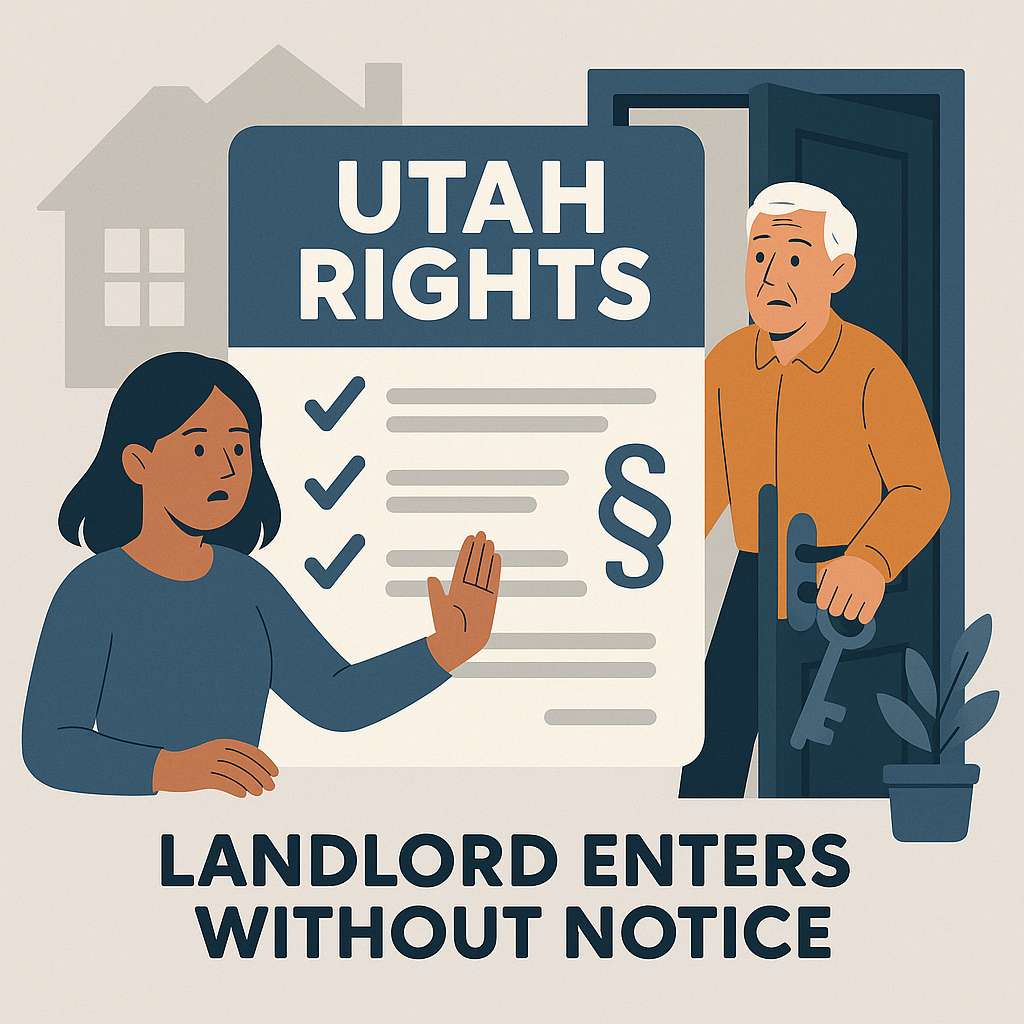
Utah Rights If Your Landlord Enters Without Notice
Plain-English guide to Utah landlord entry rules, notice, emergencies, and your right to privacy at home.
Even if they own the property, Utah landlords cannot simply walk into your home whenever they feel like it. Utah law protects a tenant’s right to privacy and quiet enjoyment while still allowing landlords to inspect, repair, or show the unit for legitimate reasons.
This guide explains when notice is required, what “reasonable” notice usually means in Utah, when emergency access is allowed, and what you can do if a landlord abuses their right of entry. The goal is to give you clear, practical steps to protect your privacy without putting your housing at unnecessary risk.
Utah Tenant Privacy and Landlord Entry Basics
Utah law tries to balance two things at the same time:
- Your right as a tenant to privacy, safety, and quiet enjoyment of your home; and
- Your landlord’s right to enter the property for valid reasons like repairs, inspections, and showings.
In real life, most problems arise when landlords treat the rental like it is still “their” space and ignore the fact that, under the law, it is also your home. That is where notice rules and limits on entry become important.
Landlords who follow Utah law will give advance notice, come at reasonable times, and only enter for legitimate purposes. Landlords who do not follow the rules may be violating your rights and, in serious cases, may be harassing you or invading your privacy.
When Utah Landlords Must Give Notice
For most non-emergency situations, a Utah landlord should provide reasonable advance notice before entering your unit. Many Utah leases specifically require at least 24 hours’ notice, and that timeframe is widely treated as the standard in practice.
Notice should clearly explain:
- Why they need to enter (repair, inspection, showing, etc.)
- When they plan to come (date and approximate time)
- How long they expect to be there
Common non-emergency reasons that usually require prior notice include:
- Routine inspections or walk-throughs
- Repairs and maintenance that are not urgent
- Pest control treatments
- Showing the unit to potential buyers or new tenants
If a landlord shows up unannounced for any of these reasons, that is usually not consistent with Utah’s notice expectations unless you agreed to it ahead of time.
What “Reasonable Notice” Looks Like in Utah
Utah law does not write a specific number of hours into the statute for all situations, so what is “reasonable” depends on context. However, some patterns are common:
- Reasonable example: A text or email on Tuesday telling you they’ll enter on Wednesday at around 3 p.m. to fix a leak you reported.
- Unreasonable example: A message saying “I’m coming in 10 minutes,” or simply appearing at your door with a key and a contractor.
If your written lease states a specific notice period (such as 24 or 48 hours), that clause usually controls, as long as it does not try to waive your basic privacy rights altogether. Clauses that say a landlord can enter anytime, for any reason, without notice may be unfair and unenforceable.
Remember: knocking at the door right before entering is not the same thing as giving advance notice.
When Landlords Can Enter Without Notice (Emergencies)
There are situations where a Utah landlord may lawfully enter your unit without giving prior notice. These are true emergency scenarios where waiting could cause serious harm.
Typical emergencies include:
- A fire or smoke coming from your unit
- A burst pipe or major water leak
- Gas smell, carbon monoxide concerns, or other safety hazards
- Situations where someone inside may be in immediate danger
In those cases, the landlord or someone acting on their behalf can enter to protect life or property. But an “emergency” does not include:
- Convenient times for a contractor
- Curiosity about how you’re living
- General check-ins with no specific safety concern
If your landlord keeps calling non-urgent issues “emergencies” in order to enter without notice, that may be a red flag and something to document.
What to Do If Your Landlord Abuses Their Right of Entry
Unannounced or repeated entries can cross the line from simple rule-breaking into harassment or invasion of privacy. Here are practical steps Utah tenants often take when that happens:
- Communicate in writing. Calmly state that you expect reasonable advance notice for any non-emergency entry and that you will not consent to surprise visits. Texts or emails are best so you have a record.
- Document every incident. Keep a log with dates, times, and what happened. Save screenshots of messages and, where safe and legal, photos or videos of damage or entries.
- Review your lease. Check what your lease says about landlord access, notice, and entry for repairs, inspections, and showings.
- Consider mediation or a complaint. If direct communication fails, you can explore mediation programs or, in more serious situations, court options. Documentation makes those steps much stronger.
- Talk to a lawyer for serious or repeated violations. For ongoing harassment, unsafe behavior, or serious privacy violations, a Utah landlord-tenant attorney can help you evaluate whether to seek damages, a court order, or in some cases, a way out of the lease.
Any “response” should be proportionate to what is actually happening. Many situations can be solved with a firm but respectful written boundary before things escalate into a legal dispute.
Scenario Breakdown: Real-Life Examples in Utah Rentals
Sometimes it is easier to understand your rights by looking at real-world scenarios similar to what Utah tenants actually face.
Scenario 1: Landlord Enters While You’re at Work
You come home and find out your landlord let themselves in “just to check on things,” even though there was no emergency.
Why this is a problem: This is a non-emergency entry that should have involved reasonable advance notice. You can respond by documenting what happened and sending a written message asking them not to enter again without proper notice.
Scenario 2: Surprise Visit with a Contractor
A contractor shows up at your door with your landlord, but you had no advance notice. They say they’re there to look at the furnace.
Your options: Unless the furnace is actively leaking gas or posing immediate danger, this is not an emergency. You can insist on rescheduling with proper notice and follow up in writing.
Scenario 3: “I Knocked First” Excuse
Your landlord says they do not need to give notice because they knocked and called your name before entering.
The reality: Knocking at the door right before coming in is not advance notice. Reasonable notice means telling you ahead of time, typically at least 24 hours so you can prepare.
Scenario 4: Repeated “Inspections” With No Clear Purpose
Your landlord insists on walking through the unit every couple of weeks with no specific reason.
Why this matters: Frequent, vague inspections can feel intrusive and may amount to harassment. This is a situation where documenting each visit and speaking with a Utah attorney can be helpful.
Scenario 5: Burst Pipe While You’re Out of Town
A pipe bursts while you are away for the weekend and the landlord enters immediately to stop the flooding.
This is appropriate: This is a true emergency. Your landlord is allowed and expected to act quickly to protect the property and your safety, then let you know what happened.
Video & Social Learning Hub: Utah Landlord Entry Rights
YouTube: Utah Landlord Entry and Tenant Rights
Need Help Applying This to Your Situation?
Knowing your Utah privacy rights helps you set respectful boundaries, prevent misunderstandings, and respond appropriately if a landlord crosses the line. But every rental situation is unique, and small facts can make a big legal difference.
Talk to a Utah AttorneyFor more plain-English legal guidance, stay updated with Utah Law Explained, explore our mission on the About Us page, or connect with trusted counsel like Gibb Law Firm.