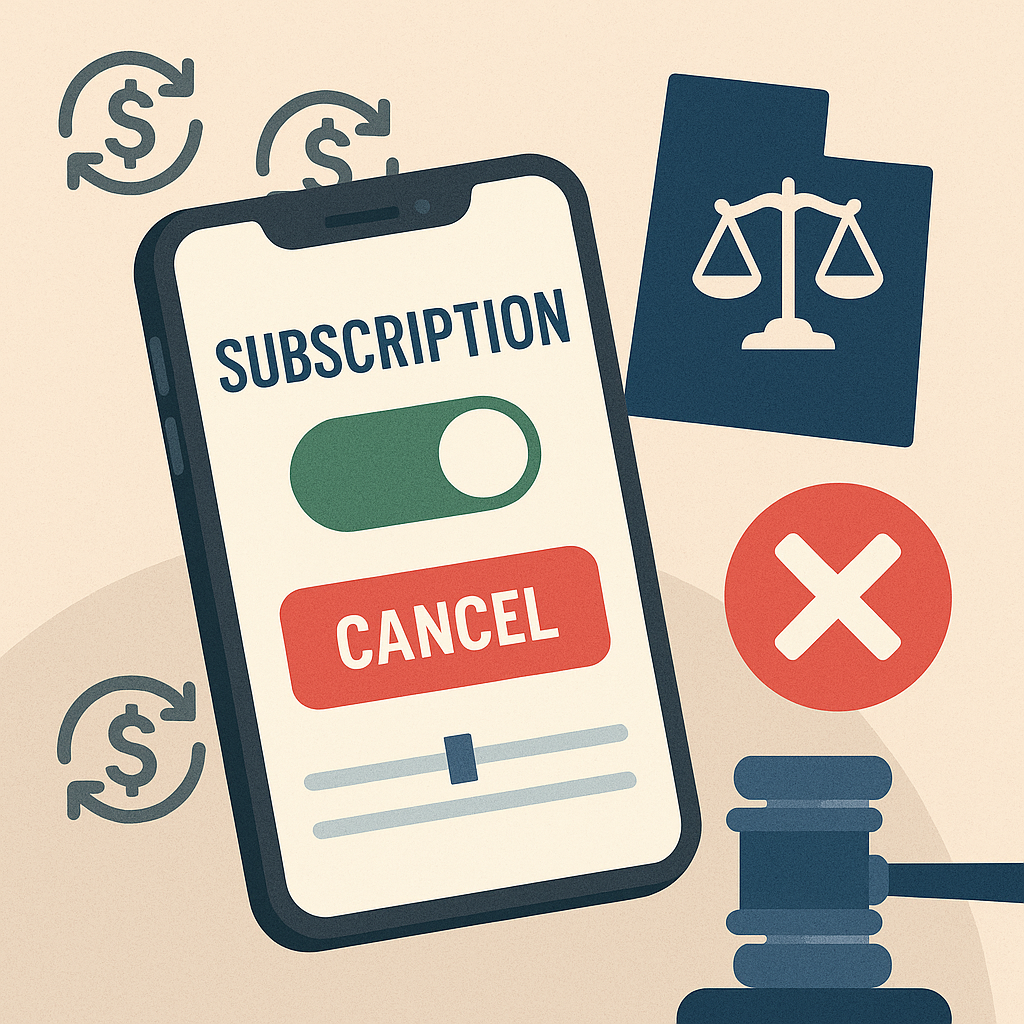
Subscription Economy Laws in Utah: Auto-Charge and Cancellation Rights
Plain-English guide to Utah automatic renewal rules, cancellation rights, and consumer protection for recurring subscriptions.
Recurring billing is convenient for Utahns, but it also causes real problems when companies hide auto-renewal terms or make cancellation confusing. Small charges can quietly stack up month after month if customers are not given clear renewal terms and a simple way to cancel.
Utah has stepped in with stronger automatic renewal rules that require businesses to be upfront about renewals, provide user-friendly cancellation options, and give clear notice before a subscription continues into the next cycle. This guide explains how Utah’s automatic renewal and “negative-option” contracts work, what rights consumers have, and what Utah businesses must do to stay compliant.
How Utah’s Automatic Renewal Law Works
Utah law restricts “negative-option” and “automatic renewal” contracts. These are agreements where you are charged again unless you cancel first. Instead of assuming that silence means “yes,” Utah expects businesses to clearly spell out renewal terms and get real, affirmative consent.
Under Utah’s consumer protection framework, automatic renewal terms must be easy to find, easy to understand, and paired with a cancellation process that is just as simple as signing up. Violations can trigger refunds, enforcement by the Utah Division of Consumer Protection, and penalties for repeated misconduct.
Core Requirements Under Utah’s Automatic Renewal Rules
To protect consumers, Utah requires businesses that use auto-renewal or subscription billing to follow several core rules. In practice, this means:
- The fact that the plan will renew automatically
- How often the charges will occur (monthly, yearly, etc.)
- The price after any promotional period ends
- How and where to cancel
- The renewal date
- The renewal amount
- How to cancel in time to avoid the next term
Clear Disclosures & Honest Pricing
One of the most common pain points in subscription contracts is unclear pricing. Utah law expects businesses to be honest and direct when explaining how much a plan costs now and how much it will cost later.
If a subscription starts with a low introductory rate and then jumps to a higher amount, that future price should be highlighted up front. Customers should not find out about a higher rate only after it has been charged. Hiding the full price in dense legal text or behind extra clicks increases legal risk and undermines trust.
Affirmative Consent & Simple, Direct Cancellation
Utah’s approach to consent is simple: customers should know what they are agreeing to and should clearly say “yes” before recurring charges begin. That means consent must be tied to the actual auto-renewal terms, not just a generic “terms and conditions” link.
On the cancellation side, Utah expects businesses to match the ease of signup with the ease of exit. If everything can be done in a few taps on a phone, cancellation should not require phone calls, long wait times, or digging for a hidden email address.
In practice, Utah consumers should not face:
- Mandatory phone calls as the only way to cancel
- Long hold times or repeated transfers to “save” teams
- Vague instructions like “email us and we’ll get back to you” with no clear timeline
When cancellation is unnecessarily difficult, those practices may be viewed as unfair or deceptive under Utah law.
Quick Reference Sheet
Here is a fast recap of what consumers and businesses should know about Utah’s subscription and auto-renewal rules.
What Consumers Get Under Utah Law
- Clear disclosure of auto-renewal terms
- Easy online or in-app cancellation when signup was online or in-app
- Advance notice for annual renewals
- Protection under Utah’s consumer protection laws for unfair or deceptive practices
- The right to dispute unauthorized or improperly billed renewals
What Businesses Must Do
- Use plain-language renewal terms that are easy to find and read
- Get active consent before any auto-renewal charge
- Provide cancellation paths that are at least as simple as signup
- Track and send required renewal reminders
- Honor cancellation requests promptly and accurately
- Maintain compliance to avoid investigations and penalties
What Happens If a Business Violates the Law
- Consumer refunds for improper or undisclosed renewals
- Fines or penalties for deceptive or unfair practices
- Mandatory changes to contracts, disclosures, and processes
- Increased scrutiny from regulators and possible damage to reputation
Common Questions About Utah Auto-Renewal Laws
Q: Do Utah laws apply to both monthly and yearly subscriptions?
Yes. Monthly renewals require clear disclosure and consent. Yearly plans also require advance renewal notices so customers have time to cancel before the next term.
Q: What if the company hides the cancellation page or makes it difficult?
That may violate Utah’s automatic renewal and deceptive practices laws. Consumers can file a complaint with the Utah Division of Consumer Protection if cancellation is overly confusing, time-consuming, or obstructed.
Q: Can a company raise the price without telling me?
Not legally. If the renewal price changes, that new amount should be disclosed clearly before the renewal takes place. Surprise price increases are a red flag for unfair or deceptive conduct.
Q: Does this apply to gym memberships, software, streaming services, and subscription boxes?
Yes. Utah’s rules apply broadly to most automatically renewing consumer contracts, including gyms, apps, digital subscriptions, software tools, and physical subscription boxes.
Q: What if I never agreed to automatic renewal in the first place?
If the company did not get active consent to auto-renew, the charge may be invalid and refundable. In disputed cases, documentation of what you saw and what you clicked at sign-up can be important.
Video & Social Learning Hub: Auto-Renewal & Subscriptions
YouTube: Utah Auto-Renewal & Consumer Protection
Instagram: Auto-Renewal Fees & Practical Tips
Need Help With a Subscription or Auto-Renewal Problem?
Subscription auto-renewals affect nearly every Utahn: streaming services, apps, gyms, software tools, and more. Understanding your rights helps you avoid surprise charges and gives you a clear path to cancel when a service no longer fits your needs.
For Utah businesses, following disclosure and cancellation rules is not just a legal box to check. It is a way to build trust, reduce disputes, and show customers that your recurring billing is transparent and fair.
Talk to a Utah AttorneyFor more plain-English legal guidance, stay updated with Utah Law Explained, explore our mission on the About Us page, or connect with trusted counsel like Gibb Law Firm.