What to Know Before Suing for Breach of Verbal Agreements in Utah
Comparison guide and quick checklist for Utah verbal contracts, Statute of Frauds, and evidence before you sue.
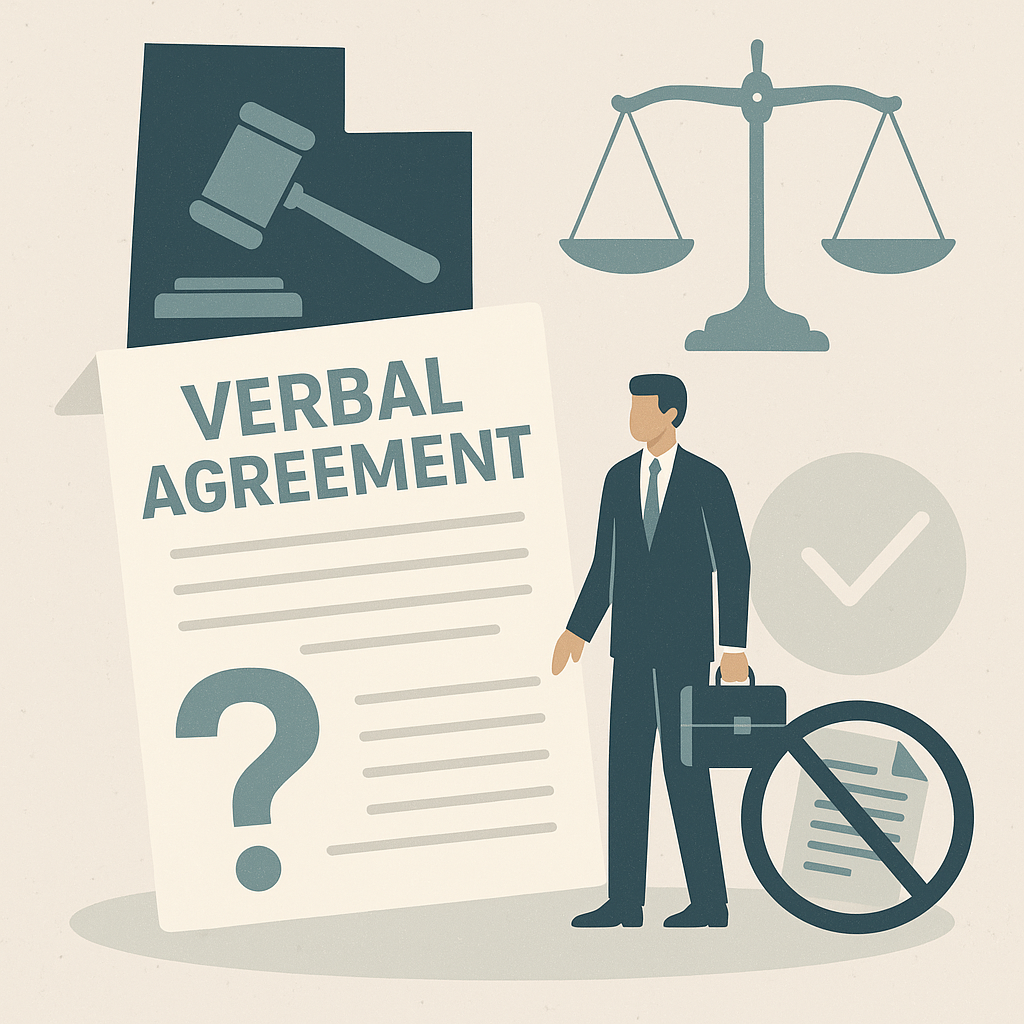
In Utah, oral promises can be legally binding but not every handshake deal will hold up in court. The key questions are whether your agreement is the type Utah law allows to be verbal, and whether you have enough proof of what was actually promised. This guide offers a side-by-side look at enforceable vs. non-enforceable verbal agreements, plus a practical, Utah-focused checklist to work through before you file a lawsuit.
Utah Law Explained is built to turn complex Utah law into plain-English steps. Below, you’ll see how Utah’s Statute of Frauds affects verbal agreements, what “part performance” means, and what evidence really matters if you end up in small claims or district court.
Enforceable Verbal Agreements in Utah
Utah courts do recognize many verbal agreements as contracts. At a basic level, the judge is looking for an offer, acceptance, and an exchange of value (consideration), even if nothing was written down.
Examples of Utah verbal agreements that are often enforceable include:
- Service agreements: paying someone to mow your lawn, fix your car, design a website, or complete one-time work.
- Short-term business deals: simple collaborations, profit-sharing on a single project, or a one-off sale.
- Agreements that can be completed within 1 year: if the deal reasonably can be finished in under a year, it usually does not have to be in writing.
- Many small claims disputes: Utah small claims courts regularly hear cases that are based on spoken agreements under $15,000.
In these situations, the real fight is usually not whether a verbal contract can exist but what the exact terms were and whether you can prove them.
When Utah Law Requires a Written Contract
Utah’s Statute of Frauds is the legal rule that decides which deals must be in writing. If your situation falls into one of these categories, a purely verbal agreement is usually not enforceable in court:
- Real estate transactions: buying, selling, or transferring an interest in land or a home.
- Long-term leases: leases that run longer than one year.
- Contracts that cannot be performed within one year: multi-year employment or long-term service contracts.
- Promises to pay someone else’s debt: agreeing to be responsible for another person’s loan or obligation.
If your dispute clearly fits one of these categories and there is no signed writing, suing for breach of a verbal agreement will be very difficult. At that point, you and a Utah attorney may be better off exploring other legal theories or settlement options.
Part Performance: The Major Exception
Even when a writing is normally required, Utah courts sometimes enforce an oral agreement if one side has already started performing based on the promise. This is often called part performance.
Examples of part performance in a Utah verbal agreement case include:
- You paid some or all of the agreed-upon price.
- You started the work or delivered services the other person accepted.
- You moved into a rental after agreeing on terms with the landlord.
- You purchased materials, made improvements, or took other costly steps in reliance on the deal.
Part performance does not automatically “fix” every missing writing, but it can convince a judge that an agreement probably existed and that it would be unfair to ignore it. Because these situations are fact-heavy, getting legal advice is especially important here.
Quick Checklist Before You Sue in Utah
Before you file a Utah lawsuit over a verbal agreement, work through this quick checklist. It can save you time, money, and frustration.
Evidence Utah Courts Look For in Verbal Agreement Cases
Because nothing was formally signed, Utah judges rely heavily on surrounding proof. Helpful evidence for a verbal-agreement lawsuit can include:
- Messages and emails: texts, emails, and DMs referencing the deal, price, or deadlines.
- Invoices and payment records: Venmo, bank transfers, receipts, or checks that match the agreement.
- Written summaries after the fact: “Just confirming we agreed to…” messages sent soon after the conversation.
- Witnesses: people who heard the promise or saw both sides act like the agreement existed.
- Proof of part performance: work you completed, materials you bought, or benefits the other person accepted.
Ultimately, judges compare each side’s story and credibility. The more consistent your timeline and documents are with your version of the verbal agreement, the stronger your Utah case becomes.
Common Utah Scenarios & Practical Tips
Verbal-agreement disputes often show up in a few familiar Utah settings:
- Home repair and contractor problems: you agreed on a price and scope of work, but the contractor disappeared or did poor work.
- Freelance and gig work: you finished a project for a Utah client who now refuses to pay, claiming there was no “real contract.”
- Informal business partnerships: friends or coworkers agreed to split profits verbally, then a dispute broke out after money came in.
- Personal loans: you lent money to a friend or relative with a promise of repayment that was never documented.
In all of these, you can strengthen your position by confirming future agreements in writing an email, text, or simple one-page contract. It’s easier to prevent a lawsuit than to win one over a conversation everyone remembers differently.
YouTube & Instagram: Verbal Agreement Lawsuits
YouTube: Suing Over Verbal Agreements
Instagram: Handshake Deals & Proof
Moving Forward After a Broken Verbal Promise
Breach of verbal agreement cases in Utah are winnable when the law allows oral contracts and your evidence is strong. The more clearly you can show what was promised, how you relied on it, and what you lost, the easier it is for a judge to enforce your rights.
Going forward, even simple deals are safer when you confirm the terms in writing an email, text, or short contract can prevent costly misunderstandings and lawsuits later.
Talk to a Utah AttorneyFor more plain-English legal guidance, stay updated with Utah Law Explained, explore our mission on the About Us page, or connect with trusted counsel like Gibb Law Firm.