
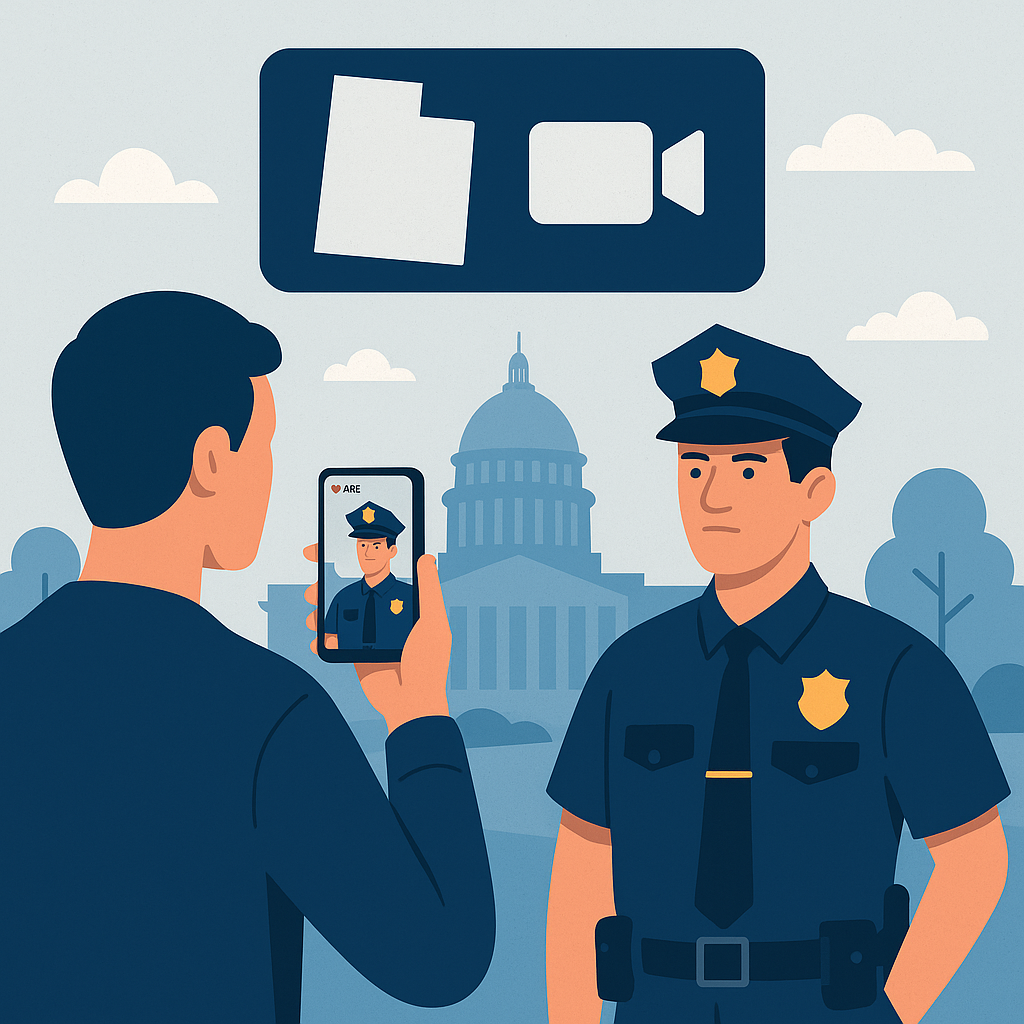
Utah Laws on Recording Police in Public
Plain-English guide to when you can record, what counts as interference, and how to stay safe while asserting your rights.
In Utah, you can legally record police officers in public but only if you do not interfere with their duties. Your right to record is protected by the First Amendment, yet officers still control the safety of the scene. This guide explains when recording is legal, what “interference” really means, how your rights work during traffic stops and arrests, and how to handle and share footage safely so you protect yourself, your community, and your evidence.
Overview: Your Right to Record Police in Utah
Utah law is generally consistent with the First Amendment: people may record police officers who are performing their official duties in public spaces. That includes taking photos, audio, or video, as long as you are in a place where you are legally allowed to be.
However, Utah also has laws that prohibit obstructing or interfering with law enforcement. Officers can give reasonable commands to control a scene. If you ignore lawful safety instructions, your conduct not the act of recording itself can become the problem.
- You may record police in public places where you can lawfully stand.
- Simply recording is not a crime, even if officers dislike it.
- Interference happens when your actions disrupt or obstruct police work.
- Police generally cannot seize or delete your footage without a warrant or emergency justification.
When & Where Recording Police Is Legal
You may typically record police in any location that is open to the public and where you have a lawful right to be. The key is to stay in areas that are not restricted or blocked off by law enforcement.
Common places where recording is usually allowed include:
- Sidewalks, streets, and intersections
- Public parks and outdoor areas
- Parking lots and other open public spaces
- Public portions of government buildings
On private property, your right to record depends on your legal right to be there and on any rules set by the property owner. Inside secured or restricted areas, police or building rules may limit access and recording altogether.
What Counts as Unlawful Interference in Utah?
Your right to record ends where interference begins. In Utah, interference is less about the camera and more about your behavior. If your actions make it harder or less safe for officers to do their job, you may be accused of obstructing or interfering with law enforcement.
Examples of behavior that may be treated as interference include:
- Standing too close to an arrest or investigation after being told to move back
- Crossing police tape, barriers, or entering an active scene
- Blocking officers, suspects, vehicles, or medical personnel
- Shouting, arguing, or escalating while officers are trying to give commands
- Reaching into pockets or moving unpredictably in a way that appears threatening
- Touching officers, detained individuals, or evidence
By contrast, quietly recording from a safe distance even if officers are unhappy about being filmed does not, by itself, equal interference. The safest approach is to stay calm, keep your distance, and follow clear safety instructions while you continue recording.
Your Rights During Traffic Stops and Arrests
You may generally record both your own traffic stop and other people’s traffic stops, as long as you do so safely and without interference.
Recording your own stop:
- You may record from your phone or dashcam during a traffic stop.
- Keep the phone in a fixed place (dashboard, mount, or passenger seat).
- Tell the officer you are recording, and keep your hands visible.
- Avoid sudden movements or reaching around once the officer is at your window.
Recording someone else’s stop:
- Stay on the sidewalk or another safe public area.
- Do not step into the roadway or close in on the vehicles.
- Follow any reasonable commands to move back or adjust your position.
If you are being arrested, you may still have footage running, but officers may need to secure the device for evidence or safety. That does not automatically give them the right to delete or alter your recording.
Scenario Breakdown: Recording Police in Real Life
Seeing how the law plays out in everyday situations can make your rights easier to use under pressure. Here are a few common scenarios:
Scenario 1: Recording an arrest on the sidewalk.
You are filming an arrest from about 20 feet away on a public sidewalk. An officer asks you to move behind a patrol car but says you can keep recording.
What this means: You should comply with the distance instruction and continue recording from the new location. You are still exercising your rights while respecting safety commands.
Scenario 2: Recording your own traffic stop.
You start recording on your phone before the officer walks up. When they arrive, your hands are on the wheel, and the phone remains in a mount.
What this means: This is typically lawful. You are documenting the interaction without interfering or creating a safety risk.
Scenario 3: Told “You can’t record here.”
An officer tells you to stop filming in a public park where a police interaction is happening.
What this means: You may calmly state that you are exercising your right to record in public. However, if the officer gives a specific safety command like “move to that corner” or “step back behind the tape” you should follow that instruction while continuing to record if possible.
Scenario 4: Police demand your phone and try to delete footage.
An officer asks to see your phone and attempts to scroll through or delete your video after a tense encounter.
What this means: Police generally need a warrant or a true emergency to seize and search your device. Deleting or altering footage should not occur. In practice, stay calm, do not resist physically, and speak with an attorney as soon as you can.
Safely Storing & Sharing Your Recorded Footage
How you handle your video after recording can be just as important as capturing it in the first place. Good habits help protect your footage and reduce unintentional harm.
Back up quickly. Use cloud services like iCloud, Google Photos, or Dropbox so videos upload automatically. That way, if your phone is lost, damaged, or taken, the footage still exists.
Be thoughtful about public posting. Before sharing online, consider whether the footage reveals faces of minors, home addresses, license plates, or sensitive medical situations. In some cases, it may be better to blur identifying details or delay posting until things calm down.
Talk to a lawyer when the video involves a potential case. If your footage shows possible misconduct, use-of-force questions, or an encounter that might lead to criminal charges or civil claims, consult a Utah attorney. Firms like Gibb Law Firm can help you understand how best to preserve, share, or present the video in a legal context.
Staying calm, visible, and non-interfering while you record and handling the footage carefully afterward helps preserve both your rights and your safety.
Video & Social Learning Hub: Recording Police
YouTube: Understanding Your Right to Record
Need Help Applying This to a Real Encounter?
Recording police in Utah can promote transparency and safety, but every situation is different. If your video is tied to an arrest, investigation, or possible misconduct, a Utah attorney can help you understand how to protect your rights and use that footage wisely.
Talk to a Utah AttorneyFor more plain-English legal guidance, stay updated with Utah Law Explained, explore our mission on the About Us page, or connect with trusted counsel like Gibb Law Firm.