
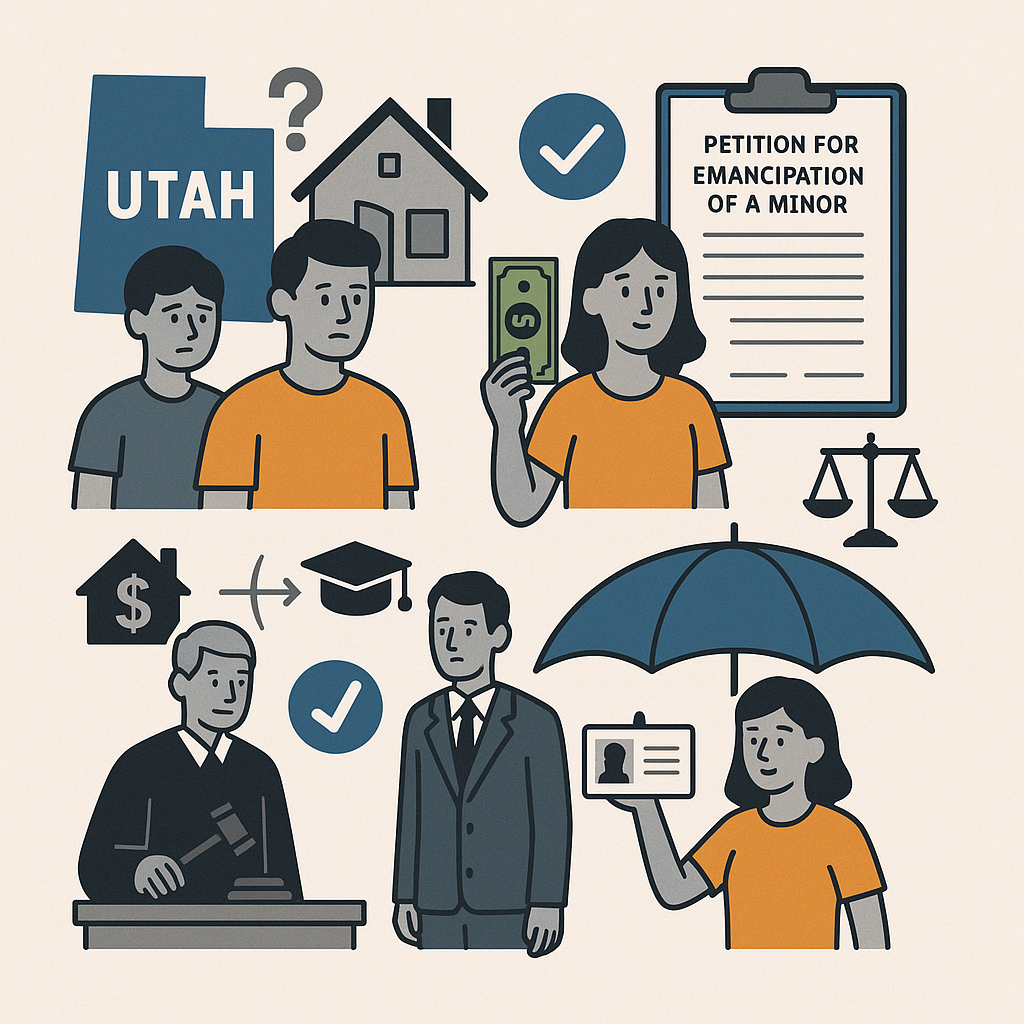
How Can a Minor Be Emancipated in Utah?
Clear steps, forms, eligibility, hearings, and what changes after emancipation
Intro. If you are a teenager or parent wondering how emancipation works in Utah, this guide walks you through it clearly. Emancipation gives a minor certain adult rights, but it also comes with serious responsibilities. Here is what Utah law actually requires and what the court will expect to see before granting it.
Eligibility and Residency
To qualify for emancipation in Utah, the minor must be at least 16 and live in the state. The court will also check that the teen is voluntarily living apart from parents or guardians and that the separation is not temporary or simply due to an unsafe home that should instead involve child protection services.
Financial independence is key. The minor must prove they can support themselves through legal employment, savings, or other reliable income. Dependence on family or government assistance usually will not meet the standard for emancipation.
Forms and Evidence to Prepare
The main filing is the Petition for Declaration of Emancipation of a Minor. Utah Courts also provide a self-help page with all forms and instructions: Emancipation — Utah Courts. You will file in the district or juvenile court for the county where the minor lives. See Utah Code 78A-6-803 (Petition).
Notice, Objections, and the Hearing
After filing, the court sets a hearing. Parents, guardians, or anyone legally responsible for the minor may attend and object. The judge reviews evidence and asks about income, housing, school progress, and maturity. If the court is satisfied that the minor understands the consequences and can live independently, emancipation may be granted. If there are gaps like unstable housing or unreliable income, the court may deny or delay the request.
What Rights and Responsibilities Change
Once emancipated, a Utah minor becomes legally responsible for themselves in most areas of daily life. This includes signing leases, getting medical care, earning income, and enrolling in school without parental consent. Some limits remain: an emancipated minor still cannot vote, drink alcohol, or engage in other activities restricted by age. Parents are no longer legally required to provide financial support or housing.
Revocation or Modification
Emancipation in Utah is not always permanent. If circumstances change, such as a loss of financial stability or a desire to reunite with parents, the minor can petition to revoke the order. Parents may also ask the court to modify if the minor becomes dependent again or fails to meet responsibilities of independent living.
Common Pitfalls
- Seeking emancipation due to conflict rather than necessity and readiness.
- Insufficient proof of steady income or safe housing.
- Assuming emancipation wipes out truancy or criminal issues. Utah law still applies.
- Missing required notices or filing the wrong forms.
Video & Social Learning Hub
Need Help Applying This to Your Situation?
Emancipation can give minors real independence, but it also shifts adult responsibilities onto young shoulders. Before filing, understand every requirement, gather strong evidence, and consider talking with a Utah family law attorney for personalized guidance.
Talk to a Utah AttorneyFor more plain-English legal guidance, stay updated with Utah Law Explained, explore our mission on the About Us page, or connect with trusted counsel like Gibb Law Firm.