
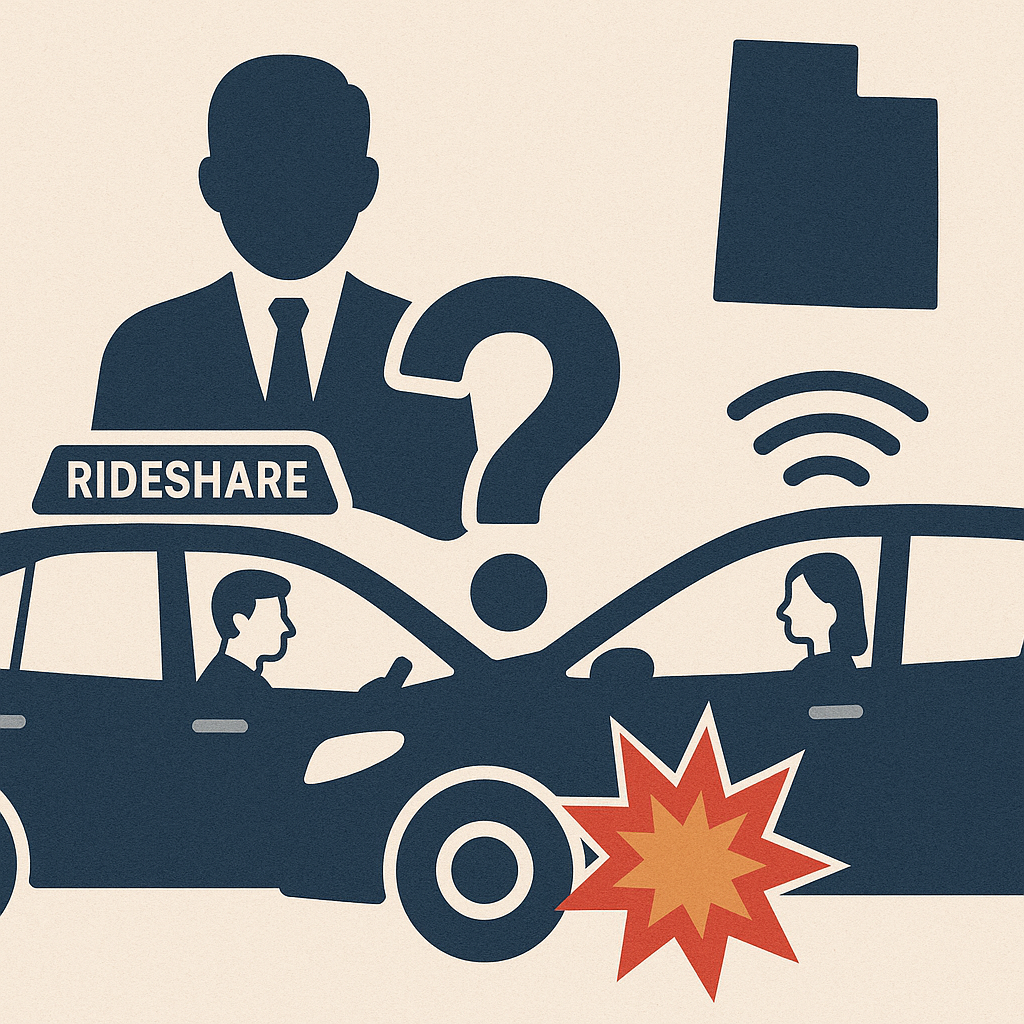
Liability Questions in Utah Rideshare and Autonomous Vehicle Accidents
Plain-English explainer on who is at fault when Uber, Lyft, or self-driving cars crash in Utah, and how insurance and negligence rules apply.
When a rideshare vehicle or self-driving car is involved in a crash in Utah, figuring out who is legally responsible is not always straightforward. Instead of just two drivers and two insurance policies, these cases can involve a human driver, a rideshare platform, advanced vehicle software, and multiple layers of coverage.
This guide from Utah Law Explained breaks down how Utah approaches rideshare and autonomous vehicle accidents, how fault is assigned, and what injured riders, drivers, and other road users can do to protect their rights.
How Utah Assigns Liability in Rideshare & Self-Driving Crashes
Utah law looks at three big questions in any rideshare or autonomous vehicle crash:
Rideshare Driver vs. Company Liability in Utah
In a typical Utah car accident, liability follows the negligent driver. With Uber and Lyft, liability depends heavily on the driver’s status in the app at the time of the crash.
1. App Off – Personal Use Only
When the driver is not logged in to the rideshare app, the trip is treated like any other personal drive. If the driver causes a crash in Utah while the app is completely off:
- The driver’s personal auto insurance is usually the primary coverage.
- The rideshare company generally is not involved in the claim.
2. App On, Waiting for a Ride Request
When the Uber or Lyft app is open and the driver is waiting for a match, they are “available” for rides but do not have a passenger yet. In this phase:
- The driver’s personal policy may still apply first.
- Rideshare companies commonly provide additional third-party liability coverage if the driver’s policy does not fully cover the loss.
3. En Route to Pickup or Transporting a Passenger
The highest level of protection typically applies once the driver has accepted a trip and is either heading to the pickup or already carrying a rider. At this stage:
- Commercial rideshare coverage is usually the main policy.
- Injured passengers, drivers in other vehicles, cyclists, and pedestrians may all make claims under this higher coverage tier.
For Utah crash victims, a key practical step is confirming which phase the trip was in. A screenshot of the trip in the app and a copy of the receipt can be very important when sorting out coverage.
Autonomous Vehicle Liability in Utah
Self-driving technology adds another layer of complexity. Depending on the vehicle and its features, a Utah crash may involve:
- A human behind the wheel using advanced driver-assistance features.
- A vehicle operating in a “hands-off” or “eyes-off” mode under certain conditions.
- Remote monitoring by a company technician.
Liability in Utah may fall on different players, including:
- The human driver if they misused the system, ignored warnings, or failed to take back control when required.
- The vehicle manufacturer or software developer if the automated system malfunctioned or was designed or marketed in a way that made crashes more likely.
- Other drivers on the road who were independently negligent.
If an automated braking system fails, a sensor misreads traffic, or the software chooses an unsafe maneuver, injured people may have a product-based claim against the companies that designed or supplied that technology, in addition to any claim against a human driver.
Mixed Responsibility: When Rideshare & Automation Overlap
Some rideshare platforms are experimenting with autonomous or semi-autonomous fleets. In these situations, liability in Utah can be divided among several different players at once:
- The rideshare driver or backup driver.
- The rideshare company, based on how it deploys and supervises vehicles.
- The vehicle manufacturer and software providers.
- Other road users who may also have driven carelessly.
Utah’s comparative fault rules allow a court or insurance adjuster to split responsibility between these parties. If an injured person is found partly at fault, their recovery can be reduced by their percentage of responsibility, and they may be barred from recovery if their share of fault is too high under Utah’s modified comparative fault standard.
Because of this, documenting what happened from every angle – human decisions, app status, and technology performance – is especially important in mixed rideshare and self-driving crashes.
What To Do After a Rideshare or Self-Driving Crash in Utah
After any collision, health and safety come first. Once urgent needs are addressed, people involved in a rideshare or autonomous vehicle crash in Utah can help protect their legal position by taking several practical steps:
- Document the scene. Take photos and video of the vehicles, road conditions, signs, signals, and any visible injuries.
- Capture the app status. If you are a rider or driver, screenshot the Uber or Lyft trip screen, confirmation, and receipt to show the timing and status of the ride.
- Ask about automation. If the other vehicle was using self-driving features, note anything said about autopilot, driver assistance, or “hands-free” systems.
- Exchange insurance information. Get contact and policy details from all drivers, and note that a rideshare or automated vehicle was involved.
- Report the crash. File a police report when appropriate and report the incident through the rideshare app if you were in an Uber or Lyft.
- Preserve records. Keep medical records, repair estimates, and correspondence with insurers or rideshare support.
Because coverage questions can be complicated in these cases, many Utahns choose to speak with an attorney early, before giving detailed statements or accepting any settlement offers.
Common Pitfalls in Utah Rideshare & AV Claims
Even strong claims can be weakened by avoidable mistakes. Some common problem areas include:
- Not capturing proof of the trip status in the rideshare app.
- Assuming only the human driver is responsible and overlooking potential claims involving the platform or technology companies.
- Waiting too long to seek medical evaluation, making it harder to link injuries to the crash.
- Handling multiple insurance adjusters alone and unintentionally giving statements that are later used to dispute fault.
Video & Social Learning Hub
YouTube: Rideshare & Autonomous Vehicle Liability
Instagram: Utah Liability & Insurance Insights
Need Help Applying This to Your Situation?
Liability questions in Utah rideshare and autonomous vehicle crashes can be complex, especially when multiple drivers, companies, and technologies are involved. If you are unsure who may be responsible or how to start a claim, a Utah attorney can help you sort through the coverage and deadlines.
Talk to a Utah AttorneyFor more plain-English legal guidance, stay updated with Utah Law Explained, explore our mission on the About Us page, or connect with trusted counsel like Gibb Law Firm.