
Utah Repossession Laws if You Fall Behind on Car Payments
Plain-English guide to when lenders can take your vehicle, what’s illegal, and what happens to your loan after repossession.
Missing a few car payments can feel terrifying and in Utah, lenders can repossess a vehicle without going to court first. But that does not mean they can do whatever they want. Utah law limits how and when repossession can happen, what counts as a “breach of the peace,” what notices you must receive, and what options you still have to get your car back or reduce what you owe.
This guide from Utah Law Explained walks you through the basics of Utah car repossession laws in plain English: when lenders can repossess without warning, which repo tactics are illegal, how redemption and reinstatement work, and what happens to your loan after the car is sold.
When Lenders Can Repossess in Utah
Under most Utah auto loan contracts, you are considered “in default” when you fall behind on required payments or violate another key term of the agreement. Once you are in default, the lender generally has the right to repossess the vehicle.
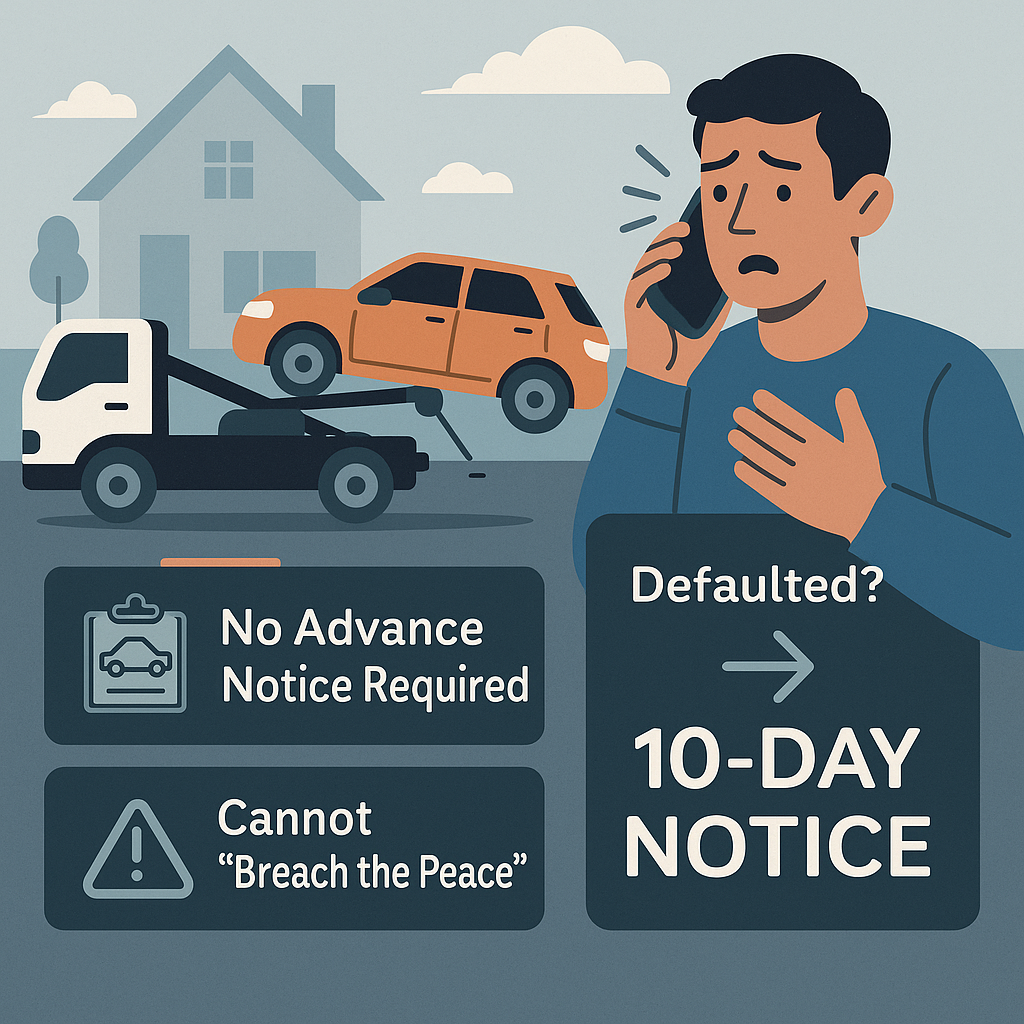
- No court order required. Utah lenders do not need to sue you first. They can use a repossession company to take the car after default.
- Little or no warning. Your contract may allow repossession after a single missed payment, even if you never receive a warning letter.
- Where repossession can happen. Repo agents can take the car from your driveway, workplace, or a public parking lot, as long as they do not breach the peace.
- Locked spaces are different. They cannot break into a locked garage, cut a lock, or damage property just to reach the car.
If your lender has given you a written payment plan or grace-period agreement and you are honoring it, sudden repossession that ignores that agreement may be improper and worth discussing with a consumer attorney.
Breach of the Peace: What Repo Agents Cannot Do
Even when you are in default, Utah law requires repossession to happen without breaching the peace. A “breach of the peace” generally means any conduct that is violent, threatening, unsafe, or seriously disruptive.
- Using or threatening physical force.
- Breaking into a locked garage, fenced yard, or gated area without permission.
- Refusing to stop when you are clearly objecting and telling them not to take the car.
- Damaging your property (for example, dragging the car so that structures are harmed).
- Creating a dangerous scene in front of children, neighbors, or at your workplace.
When a repossession involves a breach of the peace, the lender may lose the right to repossess in that manner and could be exposed to claims under Utah consumer protection laws. For more background on unfair or deceptive conduct by businesses, see our guide to Utah UDAP consumer protection laws.
Notices You Should Receive After Repossession
Once the vehicle has been repossessed, the lender is not finished. Utah law and standard UCC rules require the lender to send a post-repossession notice explaining what will happen next.
This notice typically tells you:
- How to redeem the car. The total you must pay (loan balance, late fees, repo and storage costs) to get the vehicle back before it is sold.
- Any reinstatement option. If the lender allows you to catch up by paying only past-due amounts and fees, the notice should explain how.
- Planned sale details. Whether the sale will be private or at auction and the date or time frame.
- How sale proceeds will be used. How the lender will apply the money toward your loan and costs.
- Deficiency warning. That you may still owe money if the sale does not cover the full balance.
The notice is meant to give you a real opportunity to act before the sale. If you never receive any written notice, or it arrives after the car has already been sold, that may affect the lender’s ability to collect a deficiency later.
For a broader tour of key statutes that affect everyday Utahns, including consumers dealing with debt and contracts, review our Utah legal guide to key statutes every Utahn should know.
Redemption vs. Reinstatement: Getting Your Car Back
After repossession, you may still be able to get your car back. In Utah, two common paths are redemption and reinstatement.
Redemption. Redemption means paying off the loan in full. You usually must pay:
- The entire remaining principal and interest on the loan.
- Late fees and default-related charges.
- Reasonable costs of repossession and storage.
Redemption is costly, but once you redeem the vehicle, the loan is finished. You now own the car free of that loan.
Reinstatement. Some lenders allow you to reinstate the loan instead of paying it off. With reinstatement, you typically:
- Pay only the missed payments plus fees and repossession costs.
- Bring the loan current.
- Resume your regular monthly payments going forward.
Utah law does not require lenders to offer reinstatement, and not every contract provides this option. Check your loan agreement carefully and read any notices you receive. If reinstatement is mentioned, act quickly because timelines can be short.
After the Auction: Deficiency Balances and Surplus
Once the lender sells the car, the sale money is applied to your account. What happens next depends on whether the sale price covers what you owe.
- If the sale price is lower than your balance. You may owe a deficiency balance. The lender can attempt to collect it or sue you for the amount, plus costs and possibly attorney fees if allowed by the contract.
- If the sale price is higher than your balance. You are entitled to any surplus proceeds after the loan, fees, and expenses are paid.
If the car is sold for an unusually low amount, or if the lender did not follow reasonable commercial practices in how it advertised or conducted the sale, that can affect whether a deficiency is enforceable. Problems with notice, sale method, or pricing may give you defenses if the lender later sues for a deficiency.
To understand how aggressive debt collection fits into the bigger picture of Utah law, you can also look at our in-depth insights on Utah UDAP laws and enforcement.
Utah Scenarios: What Happens If…
- You miss just one payment. Your contract may technically allow repossession, but many lenders wait until you are more than 30 days late or have a pattern of late payments. Communication with the lender early can sometimes prevent a repo.
- You find the repo agent taking your car and clearly object. Continuing the repossession despite your clear objection can become a breach of the peace. The agent should stop and leave.
- You hide the car or move it out of state on purpose. Hiding the vehicle may violate your contract and could expose you to additional legal risk. It rarely solves the underlying debt problem.
- You file Chapter 13 bankruptcy. A Chapter 13 case can stop an upcoming repossession and, in some cases, help you get a recently repossessed car back while you catch up on payments through a court-approved plan.
- You still need your car for work. Judges and lawyers understand that a car is often essential for employment and family obligations. That is one reason why people sometimes seek legal help quickly after repossession instead of ignoring collection letters or lawsuits.
If your situation also involves traffic tickets, impounds, or license issues, our Utah Road Law Q&A can give additional context on how road-related legal problems fit together.
Video & Social Learning Hub
YouTube: Utah Car Repossession & Auto Loans
Instagram: Real Repossession Stories & Risks
Need Help Applying This to Your Situation?
Every auto loan and repossession story is different, and Utah courts review each case based on its specific facts. If you are unsure whether the lender followed the rules, whether a deficiency claim is valid, or what options you have to keep your car, speaking with a Utah consumer or bankruptcy attorney can help.
Talk to a Utah AttorneyFor more plain-English legal guidance, stay updated with Utah Law Explained, explore our mission on the About Us page, or connect with trusted counsel like Gibb Law Firm.