
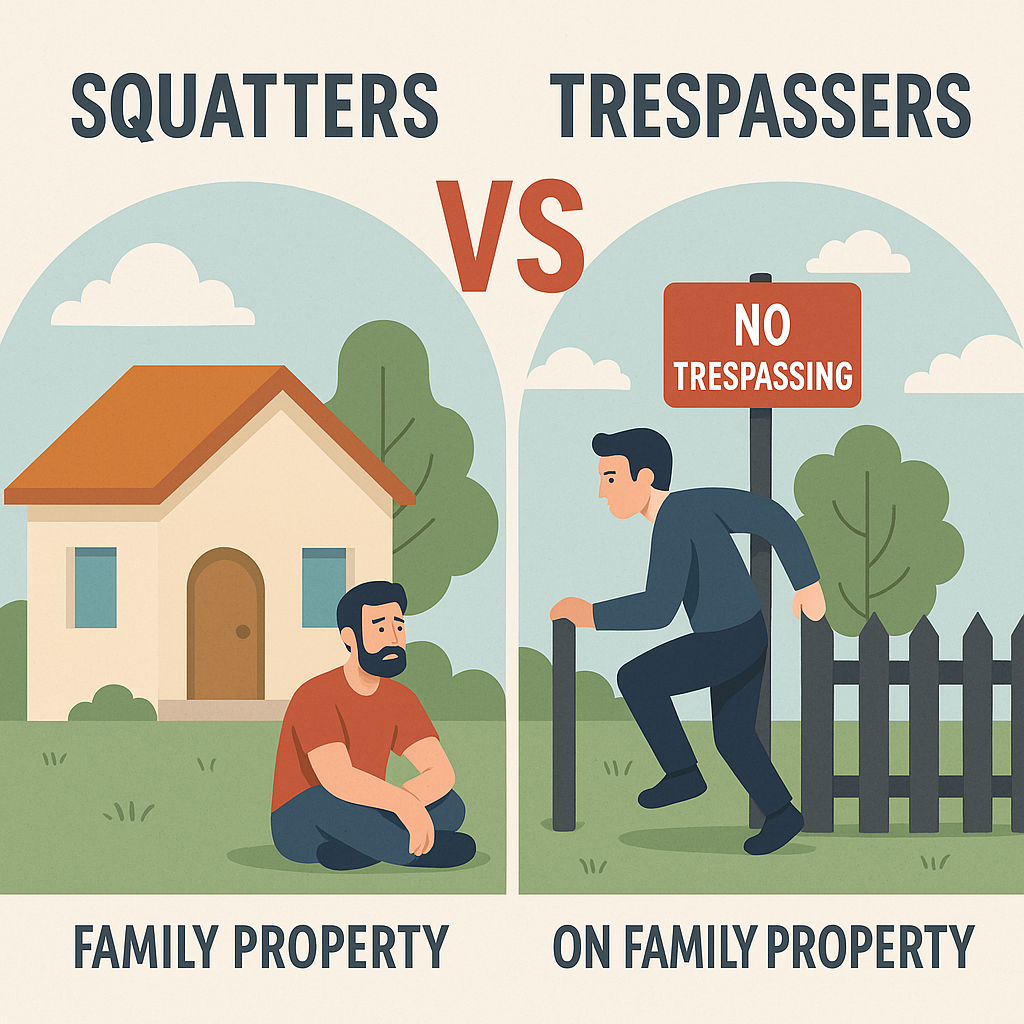
Utah Squatters vs Trespassers on Family Property
Plain-English guide to squatters, trespassers, family occupants, and how to legally protect Utah property rights
Not everyone staying on your land is a squatter. Utah law treats squatters, tenants, and ordinary trespassers very differently and misunderstanding those differences can lead to police inaction, wrongful-eviction claims, or long-term property headaches. This guide explains how Utah classifies unauthorized occupants on family property, when “squatter’s rights” (adverse possession) might come up, and what steps you can take to legally remove someone while protecting your own rights.
Utah Law Explained focuses on turning statutes and case rules into plain-English, real-world guidance for Utah families. Use this comparison guide and scenario breakdown to understand where your situation fits and which next steps are most likely to work.
Squatters vs Trespassers vs Tenants: Quick Comparison
When someone is on Utah family property without a clear rental agreement, the first question is: What are they in the eyes of the law? Trespassers, squatters, and tenants can look similar at first but your remedies depend on which category fits best.
- Trespasser. A trespasser comes onto the property without permission, does not genuinely live there, and does not claim any legal right to stay. Think of the person hanging out in your barn, garage, or backyard who leaves when told or when police arrive. Police often treat this as criminal trespass.
- Squatter. A squatter has no permission but acts like a long-term occupant: bringing belongings, changing locks, receiving mail, or telling others they “live there.” They may falsely claim to be a tenant or family member with rights. Removing a squatter usually requires a civil eviction, not just a trespass call.
- Tenant or “Implied Tenant.” If the person was invited in at first even informally and stayed for a period of time, Utah courts may see them as a tenant. That can be true even if rent was never written down, especially in family settings where people contribute with money, repairs, or caregiving.
For rental-type disputes and family occupants who were originally invited, the Utah landlord–tenant law hub offers broader context on deposits, notices, and mediation options.
How Utah Law Classifies Unauthorized Occupants
Utah courts and law enforcement look at more than just labels. They focus on how long the person has been there, whether they were ever allowed in, and what they are really trying to do on the property.
Adverse Possession and “Squatter’s Rights” in Utah
“Squatter’s rights” is usually shorthand for adverse possession a doctrine that allows someone who occupies land for a long time, under strict conditions, to eventually claim ownership.
Under Utah law, a successful adverse-possession claim typically requires:
- Many years of continuous occupation (often at least seven years);
- Open and obvious possession not hiding the use of the property;
- Hostile or non-permissive use the true owner did not consent; and
- Payment of property taxes and, in many cases, some color of title (a document or claim that appears to give rights).
Most modern squatters never meet these requirements. But long-running family disputes especially on inherited land or farm property can become complicated if one side lives on the land for years while others are absent. For broader context, the guide on key Utah legal statutes can help you understand how adverse possession fits into the larger system.
Family Property Scenarios: Squatter or Trespasser?
Here are common ways Utah family-property disputes show up in real life, and how they are often viewed legally.
- Relative who was invited “for a few weeks” but never left. Because they were originally allowed in, they are rarely treated as trespassers. Even without a written lease, the situation often looks like a landlord–tenant or civil occupancy dispute that may require eviction.
- Stranger moves into a vacant home or cabin. If someone breaks in, changes the locks, brings furniture, and says they live there, they are behaving like a squatter. Police may be cautious if the person claims a right to stay, so owners often end up in civil court to remove them.
- Person camping in a shed, barn, or detached structure. If they do not claim residency or ownership and simply occupy an outbuilding without permission, this is closer to straightforward trespass. In clear cases, officers may be more willing to remove them.
- Estranged sibling claims “I own half this property.” When co-owners or heirs disagree about who owns what, it may be a title problem rather than squatting. Disputes like this can involve quiet-title or partition actions and sometimes benefit from tools like housing mediation, which our guide on Utah housing mediation trends discusses.
In each scenario, how the person got onto the land and how they behave once there matters just as much as how long they have stayed.
How to Legally Remove Unauthorized Occupants in Utah
Once you understand whether someone is a trespasser, squatter, or tenant-like occupant, you can choose a path that matches Utah law instead of relying on threats, lock changes, or informal agreements that may backfire.
- Step 1: Identify their legal status. Ask: Were they ever invited in? Do they claim to live there? Do they say they pay rent or contributed money or labor? Their answers often determine whether police will act or whether you must use eviction.
- Step 2: Use police for clear trespass. If the person obviously does not live there, has no belongings there, and has no colorable claim, you can usually call law enforcement, show proof of ownership, and ask for removal under Utah’s trespass laws.
- Step 3: Use eviction for squatters or civil occupants. If they have been staying there, brought belongings, or claim tenant status, you will often need to serve proper written notice and file an eviction. That process is similar to other Utah landlord–tenant cases and connects closely with topics in our property management licensing Q&A.
- Step 4: Avoid self-help tactics. Changing locks, shutting off utilities, or removing belongings without a court order can expose owners to wrongful-eviction claims, even when the occupant is deeply frustrating or manipulative.
- Step 5: Document everything. Keep photos, texts, written notices, and a timeline of when the person arrived, what was said, and how they have used the property. Good documentation makes it easier for a Utah attorney or judge to see what actually happened.
When an occupant mixes civil rights with shady behavior, some families also explore consumer and deception protections areas covered in our overview of key points on Utah UDAP laws.
Police vs Civil Court: Who Handles What?
One of the most frustrating parts of dealing with squatters and trespassers in Utah is hearing, “It’s a civil matter,” from law enforcement. Understanding that line helps you decide whether to call the police, file in court, or both.
Police are more likely to act when:
- The person clearly does not live there (no bed, no mail, no long-term belongings).
- There is obvious forced entry, vandalism, or other criminal behavior.
- The person does not claim to be a tenant, co-owner, or family member with rights.
- There is an immediate safety issue, such as threats, weapons, or ongoing criminal activity.
Police are less likely to act and may refer you to civil court when:
- The person says “I live here,” “I pay rent,” or “I was invited to stay.”
- They have furniture, clothing, pets, or mail on-site.
- Family members or co-owners disagree about whether the person may stay.
- The dispute is mostly about money, control, or relationships rather than immediate physical danger.
In those gray-area cases, owners typically need a court order often through eviction or a related civil action before officers will physically remove someone from the property.
Video & Social Learning Hub: Squatters vs Trespassers
YouTube: Squatters, Trespassers & Eviction Basics
Instagram: Squatter Stories & Utah Perspectives
Need Help Applying This to Your Situation?
Handling squatters, trespassers, and long-term family occupants the right way can protect your property rights and help you avoid wrongful-eviction claims. Every set of facts is different, and Utah courts look closely at permission, intent, and history when deciding what happens next.
Talk to a Utah AttorneyFor more plain-English legal guidance, stay updated with Utah Law Explained, explore our mission on the About Us page, or connect with trusted counsel like Gibb Law Firm.