
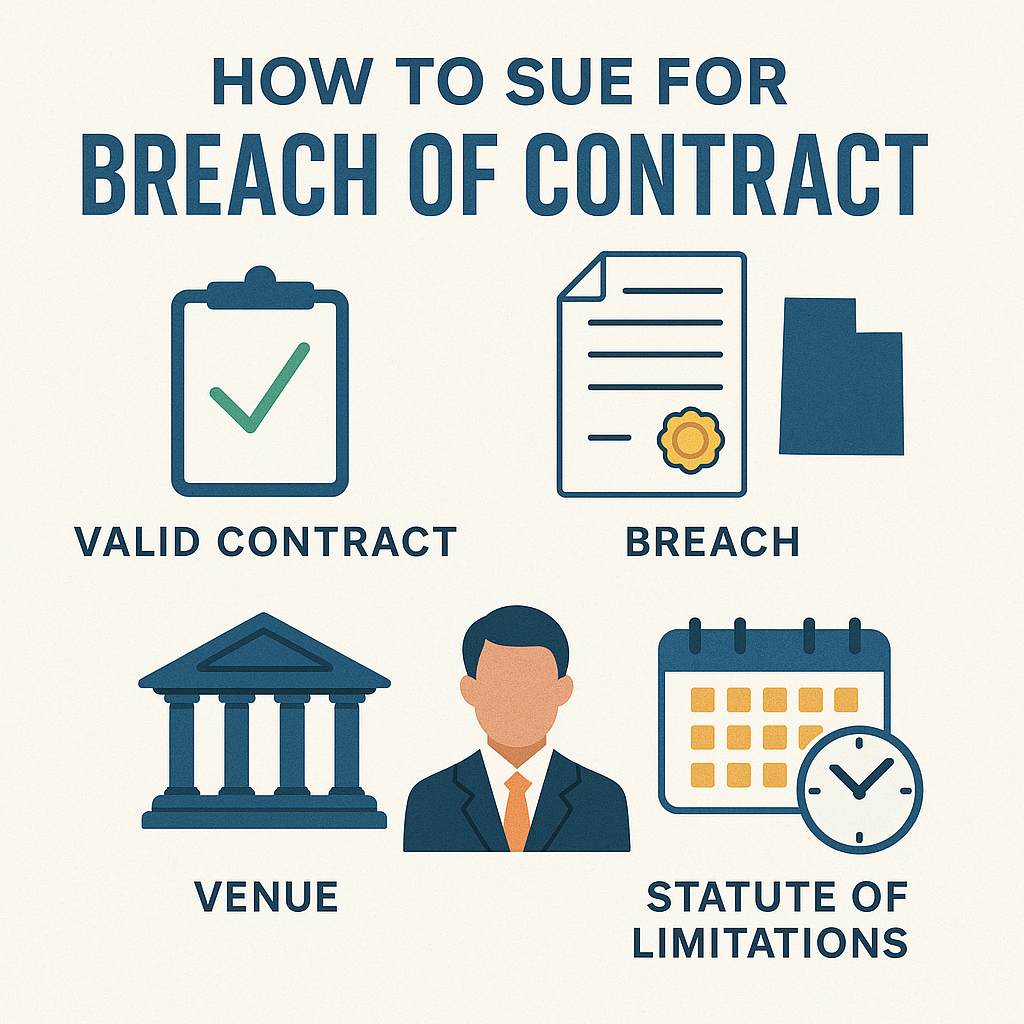
How to Sue for Breach of Contract in Utah
Required elements, where to file, and Utah statute of limitations
If someone breaks a contract in Utah, you may be able to sue. This guide explains what you must prove, where to file, and how long you have to act. Contracts power both personal and business relationships in Utah. When a promise is not kept, Utah law gives you a path to recover losses or enforce the deal.
What Counts as a Valid Contract
To sue for breach, first show there was a valid, legally enforceable agreement. Utah typically recognizes a contract when these elements are present:
- Offer — one party proposed clear terms.
- Acceptance — the other party agreed to those terms.
- Consideration — something of value was exchanged.
- Mutual intent — both sides intended a binding deal.
- Capability — both were legally capable of contracting.
A contract does not always have to be in writing, but written terms are much easier to prove in court.
The Legal Elements of a Breach Claim
Under Utah breach of contract law, you generally must prove four things:
- A valid contract existed.
- You performed your part or had a valid excuse.
- The other party failed to perform.
- You suffered damages as a result.
Courts look at evidence like emails, invoices, the agreement, payment records, and witness statements.
When Breach Occurs and How Damages Work
A breach happens when a party fails to perform a major duty without a legal excuse. Examples include not delivering goods, not paying, or performing below the agreed quality.
Utah courts typically measure damages in three ways:
Filing in Small Claims vs. District Court
Where you file depends on the amount and relief sought:
- Small Claims Court — up to $15,000. Faster and often without attorneys.
- District Court — above $15,000 or when seeking injunctions or other equitable relief.
Gather the contract, communications, and proof of payment or performance before filing.
Utah Statute of Limitations
- Written contracts — generally six years (Utah Code § 78B-2-309).
- Oral contracts — typically four years (Utah Code § 78B-2-307).
If you miss the deadline, the court will likely dismiss the case, even with strong evidence.
Common Defenses to Breach
- Impossibility due to uncontrollable events.
- Waiver by the other party.
- Lack of consideration.
- Fraud or misrepresentation.
- Duress at the time of contracting.
Courts examine the facts closely, so targeted evidence matters.
Case Scenario: Utah Small Business Partners
Two Salt Lake City partners agree to share profits from a landscaping business. One secretly takes side jobs with company equipment and hides the income. The other sues for breach.
The plaintiff presents the signed partnership agreement, invoices, and bank statements showing unpaid profits. The court awards compensatory damages for lost revenue. Clear documentation and a clean timeline carry the day.
Preparing Evidence Before You File
- The contract (written or digital).
- Emails or texts showing expectations and promises.
- Proof of performance, such as receipts, delivery records, or milestones.
- Any written notice you sent about the breach.
Organized evidence speeds the case and improves credibility, even in small claims.
Related Utah Code Sections
- Utah Code § 78B-2-307 — Limitation for oral contracts.
- Utah Code § 78B-2-309 — Limitation for written contracts.
Video & Social Learning Hub
YouTube: Utah Breach of Contract
Instagram: Utah Contract Law Tips
Need Help Applying This to Your Situation?
If you believe someone has broken a contract with you in Utah, act promptly and stay within the filing deadline. Understanding these rules gives you an edge whether you are enforcing a deal, recovering losses, or defending a claim.
Talk to a Utah AttorneyFor more plain-English legal explainers, visit Utah Law Explained. This article is legal information, not legal advice.